Leave A Message
If you are interested in our products and want to know more details,please leave a message here,we will reply you as soon as we can.

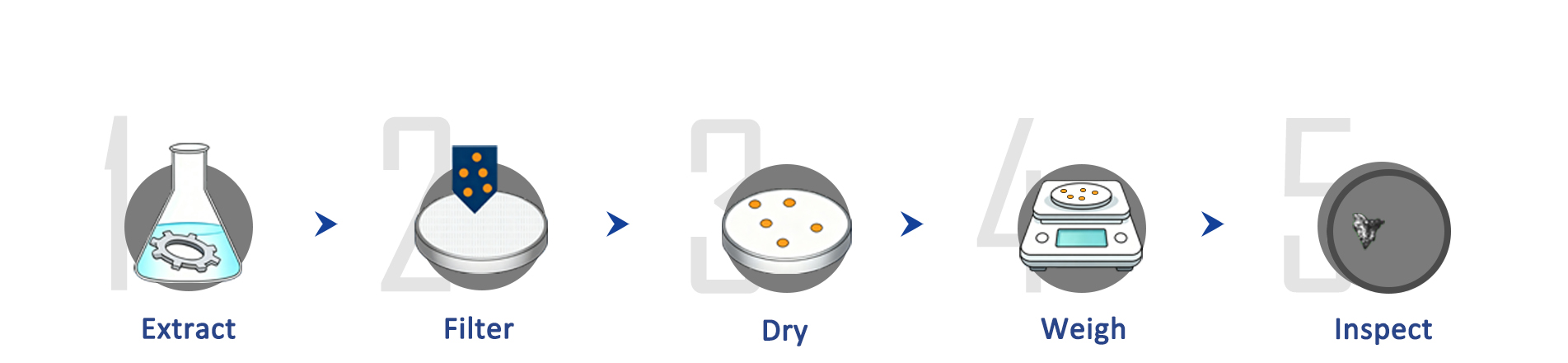
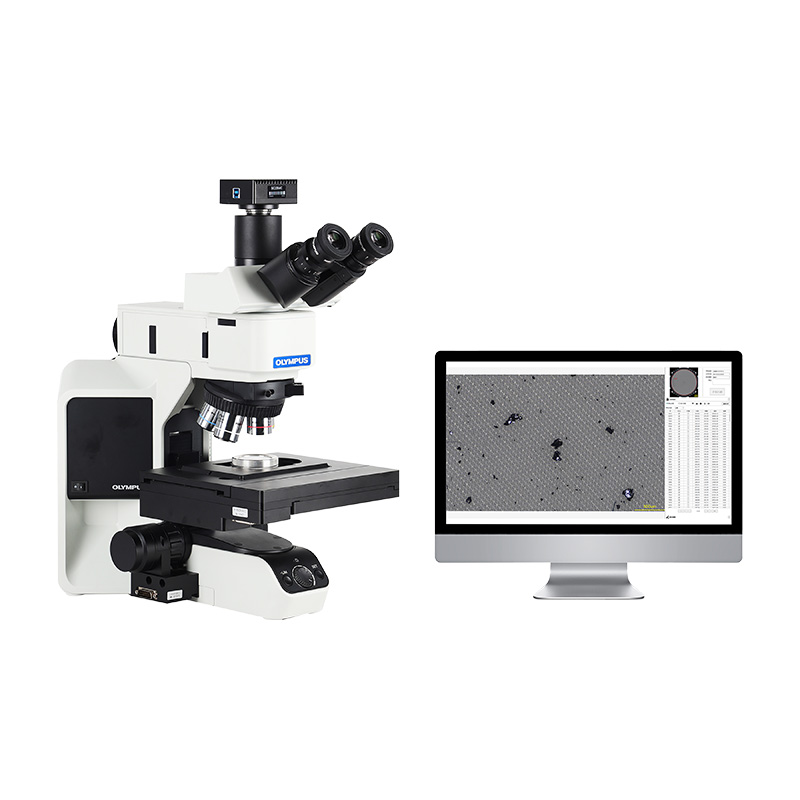
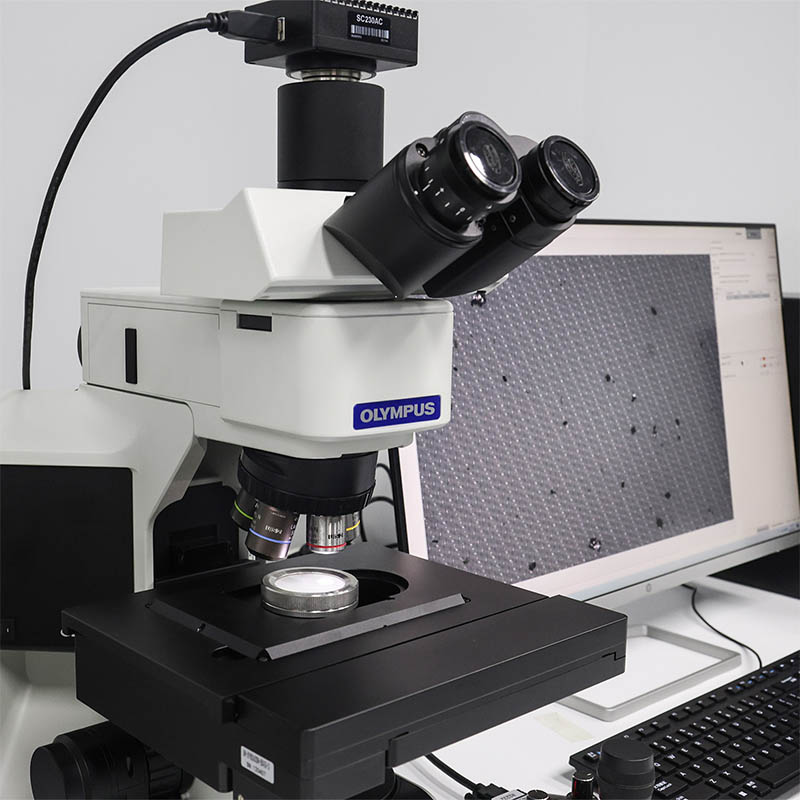
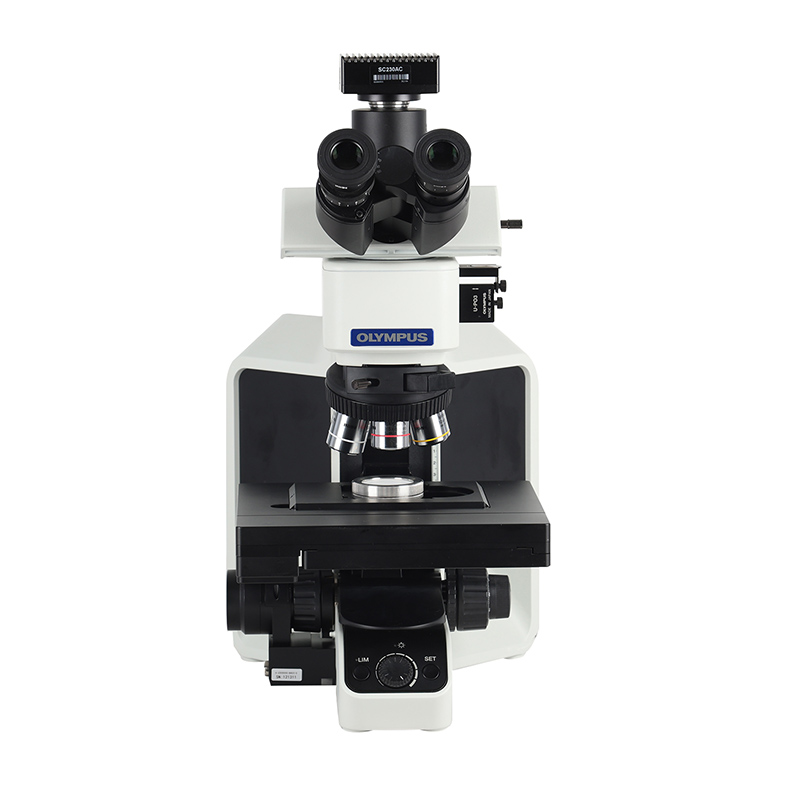
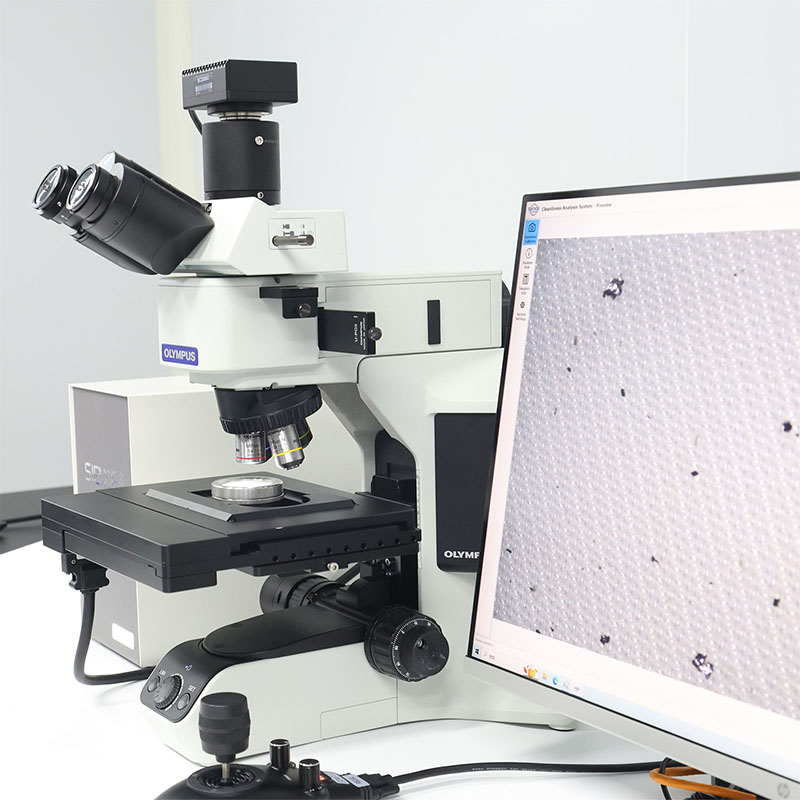
The SinAPC53M Technical Cleanliness Analysis System can automatically count and analyze the type, size, and quantity of contaminant particles on the filter membrane, and classify them by size grade. It meets the standards of VDA19, ISO16232, NAS1638, ISO4406 and other standards. The metallic particles, non-metallic particles and fibers which larger than 5μm can be identified in 5 minutes, particle height also can be measured. The repetition accuracy is above 99% (membrane scanned repeatedly for 10 times).
| Description |
Brand and Model:
-Brand:XIENS
-Model:SinAPC53M Technical Cleanliness Analysis System
Purpose of the Device:
-Used to count and analyze the type, size, and quantity of contaminant particles on the filter membrane, and classify them by size grade.
Equipment Component:
-Japanese Olympus BX53M high-depth-of-field microscope
-Motorized High-precision Scanning Stage
-High-definition Imaging System
-Technical Cleanliness Software
-High Performance Computer
Performance:
-Japanese Olympus BX53M research-grade upright metallographic microscope (for detecting particles ≥5μm) provides customers with more comprehensive solutions with excellent imaging performance and comfortable operating experience.
-Repeat accuracy of X ,Yand Z axis fully automatic control scanning stage≤1μm; Stroke: 80mm*60mm; Maximum speed≥100mm/s; Minimum step size: ≤200nm.
-HD color CMOS camera with USB 3.0 interface possess accuracy of 0.5μm/pixel, actual pixels of 2.3 million, High frame rate of 40 frames/second and fast capture speed without lag.
-Professional cleanliness analysis software features streamlined and simplified processes; with functions such as seamless stitching technology, repeated positioning of each particle, full image browsing, particle statistics, automatic evaluation, and one-click export of professional reports, ensuring high efficiency, accuracy and reliability.
-Operating system: Windows 10/64-bit operating system is featured and the computer hardware configuration is not lower than: CPU-I7 octa-core, 1TB HD, 16GB memory, 1TB hard disk, 21.5-inch HD display.
| System Composition |
|
SinAPC53M Technical Cleanliness Analysis System |
|||
|
1 |
Microscope |
Olympus |
Olympus (Japan) Upright Metallographic Microscope BX53M |
|
2 |
Vertical illuminator |
||
|
3 |
Standard 5X and 10X objectives |
||
|
4 |
Optical magnification: 50-100x Pixel magnification: approximately 450x(Under the condition of 5X objective lens) |
||
|
5 |
Camera |
Sony IMX174 |
CMOS Sensor |
|
6 |
Effective pixels: 230W |
||
|
7 |
Interface type:USB3.0 |
||
|
8 |
Resolution: 1920 × 1200 |
||
|
9 |
Pixel size: 5.6*5.6μm |
||
|
10 |
Resolution: 0.5um/pxi |
||
|
11 |
Frame rate:40 frames |
||
|
12 |
Light Source |
XIENS |
Industry-unique dual polarization (Patented Technology, Patent No.: CN22150999U) |
|
13 |
Fully automatic polarization switching |
||
|
14 |
Software automatic control |
||
|
15 |
Motorized Platform |
Axioscope7 |
X, Y, Z-axis fully automatic control scanning stage: Repeatability ≤2μm; Stroke: 80mm*60mm; Maximum speed ≥100mm/s; Minimum step ≤200nm Z-axis resolution: 0.1μm. Stroke height: 50mm |
|
16 |
Particle Standard Slide |
Germany |
Model: opto |
|
17 |
Material: glass |
||
|
18 |
Number of particles: 224 (higher than 64 in the industry) |
||
|
19 |
Maximally simulate the actual morphology of particles Particle shapes: circular, hollow circular, elliptical, rectangular, S-shaped, etc.; not a single straight line |
||
|
20 |
Computer |
DELL |
Operating system: Windows 10/64-bit; computer hardware configuration not lower than: CPU-I5 octa-core, 1TB HD, 16GB memory, 1TB hard drive, 21.5-inch HD display |
|
21 |
Software |
Clean |
Professional cleanliness analysis software with functions including one-click operation, repeated positioning of each particle, particle statistics, automatic evaluation, one-click export of professional reports, etc., lifetime free upgrade |
|
22 |
Repeatability |
99% |
Repeatability ≥99% after scanning the filter membrane ten times |
|
23 |
Detection Accuracy |
5um |
Actually measured to detect particles ≥5μm In accordance with VDA19.1 standard, it is recommended to analyze particles ≥15μm with a stereomicroscope (with a zoom ratio ≤16:1) |
|
24 |
Scanning Method |
Fully automatic |
One-click fully automatic scanning, automatic generation of particle data, and one-click report export |
|
25 |
Analysis Duration |
Fast |
For filter membranes with a diameter of 47/50mm, the time from a single analysis to result output is no more than 3 minutes |
| Performance Features |
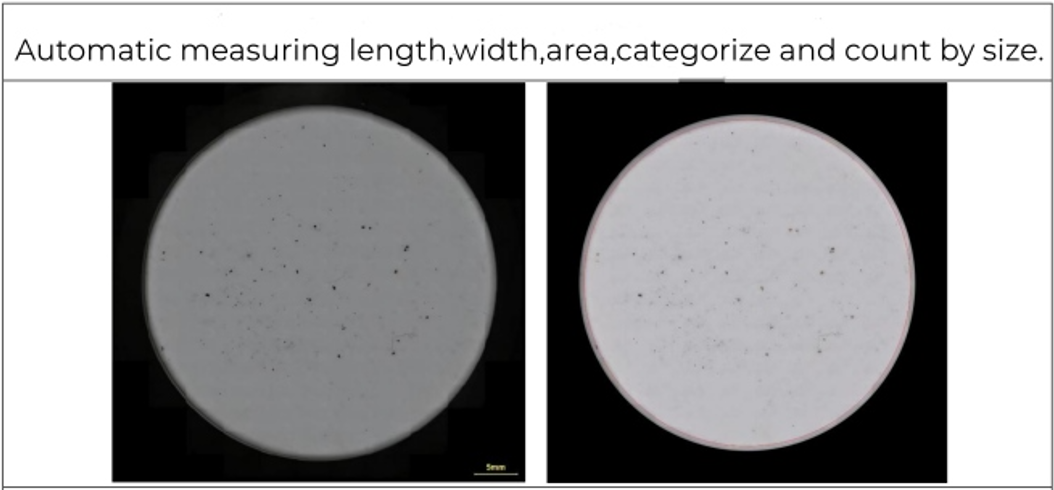
1.The scanning and evaluation time for a single filter membrane should be controlled within 6 minutes (under the condition of a 5× objective lens, with a total magnification of no less than 50×).
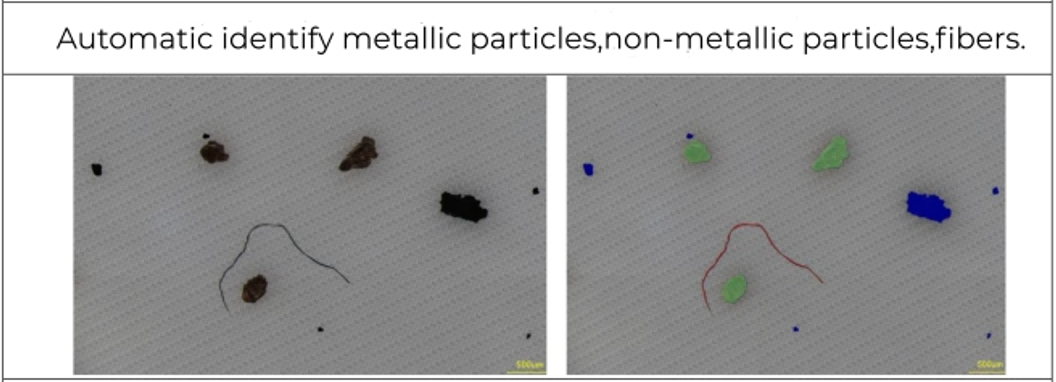
2.The analysis can accurately distinguish metal particles, non-metal particles, and fibers, so as to have standard data basis for judgment.
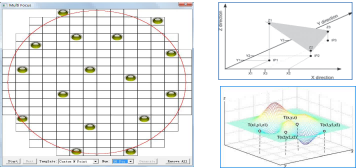
3.To address the issue that the uneven surface of the filter membrane causes failure to capture all sharply focused images during scanning, the system adopts a multi-point decentralized and fully automatic recognition and focusing method. It eliminates the need for personnel to manually select focusing points in advance, thereby achieving the fully automatic focal length compensation function.
4.The software interface can be switched between Chinese and English.
5.The equipment automatically adjusts light intensity, automatic focusing, performs multi-field automatic scanning, automatically collects images, and conducts automatic particle statistical analysis.
6.The equipment can accurately and automatically focus on and calculate the sizes of both large and small particles in the same scanning area.
7.It can classify and determine grades according to length grades based on ISO16232-2018, VDA19-2015, NAS1638, ISO4406, ISO4407 and enterprise-defined standards, and can calculate the total length of fibers on the filter membrane.
8.In accordance with the ISO16232/8 grade setting, when the same standard sample is tested repeatedly for 10 times, the repeatability is as high as 99%.
9.According to customer requirements, particles of different sizes ranging from 5μm to 3000μm and above can be classified, counted and evaluated.
10.It can also accurately identify large particles with a diameter of more than 2mm. The system can automatically measure and calculate the size parameters of a single particle, such as area, width, and inscribed circle.
11.Operators can freely add the functional items that need to be reflected in the report in the software, and the software has an automatic memory function. It abandons the traditional way of selecting the corresponding template.
12.After scanning the filter membrane, it should have the capabilities of automatic particle statistics, automatic thresholding, and automatic particle identification without human intervention to reduce misoperations. However, it retains the functions of manually modifying the scanning results so as to splitting or associating particles of any shape.
13.Image acquisition device: a color high-definition camera, which can cooperate with an automatic microscope to perform automatic color balance, automatic scanning, and automatic image acquisition.
14.The system should have the ability to restore the color of particles to facilitate the naked eye to distinguish particles with different metal colors.
15.After a single scanning and evaluation, the software should be capable of reselecting the analysis area for re-analysis (this action should not require re-scanning the filter membrane), so as to extract particles that may be lost at the edge of the filter membrane.
16.Equipped with a high-precision automatic scanning stage with free travel, featuring both automatic and manual control modes. The overall accuracy of the scanning stage and equipment as well as the detection results are ultimately controlled by standard.
17.The cleanliness analysis report shall include product model, customer name, inspection requirements, inspection date, inspection equipment model, inspector, inspection pictures, evaluation results, etc. The cleanliness analysis report can be saved and printed.
18.Evaluate the total number of contaminants per filter membrane, the total number of contaminants per part, and the total number of contaminants in the projected area of 1000cm² proposed in the evaluation results according to VDA19-2015, and present them in the form of a report.
19.The software can automatically stitch scanned images and store the scanned image of the entire filter membrane; the stored filter membrane images can be retrieved at any time for re-analysis, storage, and automatic export of office and word reports; the particle grades in the report template can be set according to user needs.
20.Equipped with a dedicated filter membrane holder. Once the filter membrane is placed, it can be directly scanned without repositioning, and it is compatible with filter paper specifications ranging from Ф47mm to Ф50mm.
21.The scanning data performance of nylon mesh woven membranes is the same as that of surface filter membranes, and the results are not affected by the mesh.
22.System calibration ruler, specification: 1/100μm
23.To ensure the reliability of equipment accuracy, standard slices (OPTO particle standard slices) used by benchmark host factories shall be provided for scanning and verifying the equipment, which are used for calibrating the equipment accuracy.
24.The analysis system should be equipped with active anti-vibration capability.
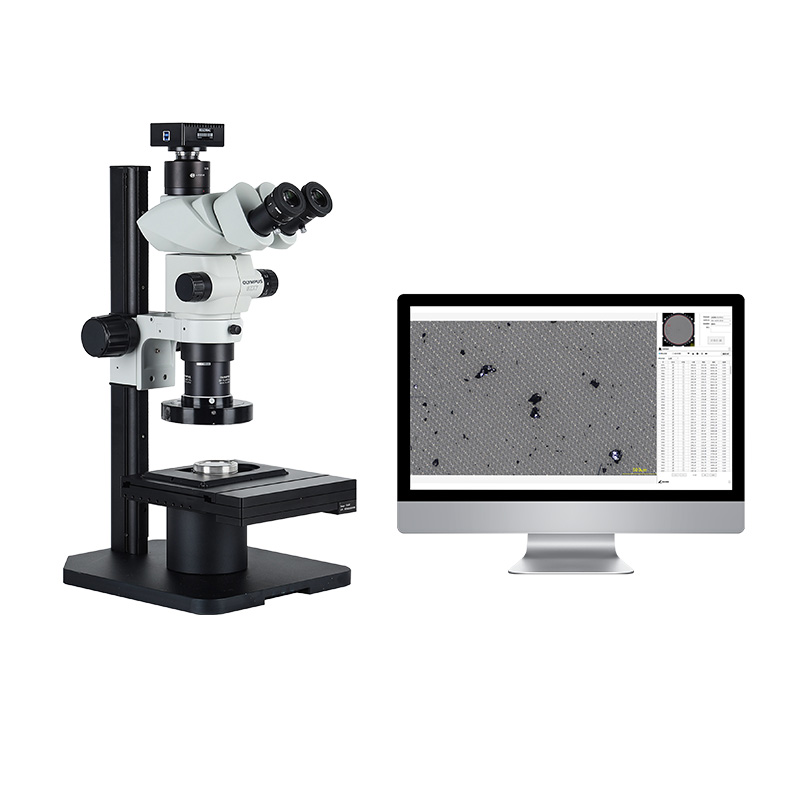
SinAPC15A technical cleanliness inspection system is used for cleanliness testing of automotive component samples. It can automatically count and analyze the type, size, and quantity of contaminant particles on the filter membrane, and classify them by size grade. It meets the specification requirements for component cleanliness testing standards such as VDA19, ISO16232, NAS1638, ISO4406, ISO4407 and so on. The metallic particles, non-metallic particles and fibers which larger than 15μm can be identified in 3 minutes. The repetition accuracy is above 98% (membrane scanned repeatedly for 10 times).
Read More
The SinAPC53M Technical Cleanliness Analysis System can automatically count and analyze the type, size, and quantity of contaminant particles on the filter membrane, and classify them by size grade. It meets the standards of VDA19, ISO16232, NAS1638, ISO4406 and other standards. The metallic particles, non-metallic particles and fibers which larger than 5μm can be identified in 5 minutes, particle height also can be measured. The repetition accuracy is above 99% (membrane scanned repeatedly for 10 times).
Read More


 IPv6 network supported
Leave A Message
Scan to Wechat :

Scan to Whatsapp :

 English
 Français
 Русский
 Español
 Português
 عربي
عربي Get A Quote