Leave A Message
If you are interested in our products and want to know more details,please leave a message here,we will reply you as soon as we can.

VDA 19 History: Evolution of the Technical Cleanliness Standard for Automotive & EV Components
VDA 19 is one of the most influential technical cleanliness guidelines in the automotive industry. Since its first edition in 2004, it has evolved alongside increasingly stringent requirements for particulate contamination control in automotive components. From the introduction of VDA 19.2 for assembly cleanliness to the third revised edition of VDA 19.1, officially published in February 2026, the guideline continues to develop to meet modern manufacturing and inspection requirements. This article explores the history of VDA 19, its relationship with ISO 16232, and the major updates in the latest edition.
Microscopic particulate contamination can cause serious failures in high-precision automotive components, including fuel injection systems, hydraulic valves, braking systems and other functional parts. As component tolerances become tighter and system designs more complex, controlling residual particles has become an essential part of automotive quality management.
Today, VDA 19 is widely referenced by automotive OEMs, Tier 1 suppliers and manufacturers of precision components worldwide.
VDA 19 is a technical cleanliness guideline series published by the German Association of the Automotive Industry (Verband der Automobilindustrie, VDA). It provides guidance on evaluating particulate contamination in functionally relevant automotive components and controlling cleanliness throughout manufacturing and assembly processes.
The guideline consists of two main parts:
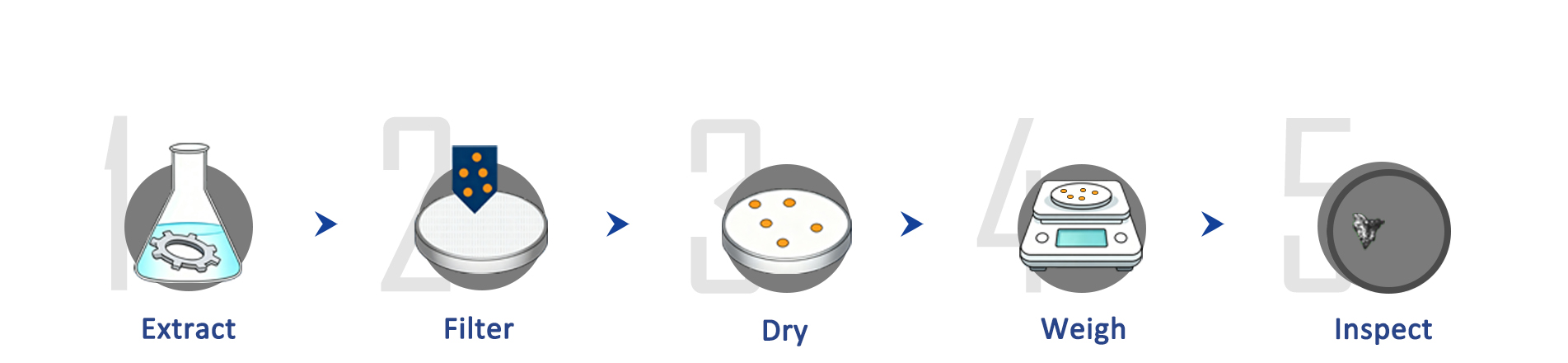
VDA 19.1 – Inspection of Technical Cleanliness: Focuses on laboratory inspection of component cleanliness, including particle extraction, filtration, particle measurement, counting and material analysis.
VDA 19.2 – Technical Cleanliness in Assembly: Addresses cleanliness control during manufacturing and assembly, covering production environments, personnel, equipment, handling, packaging and logistics.
Together, these two guidelines address both the measurement of component cleanliness and the prevention of secondary contamination during production.
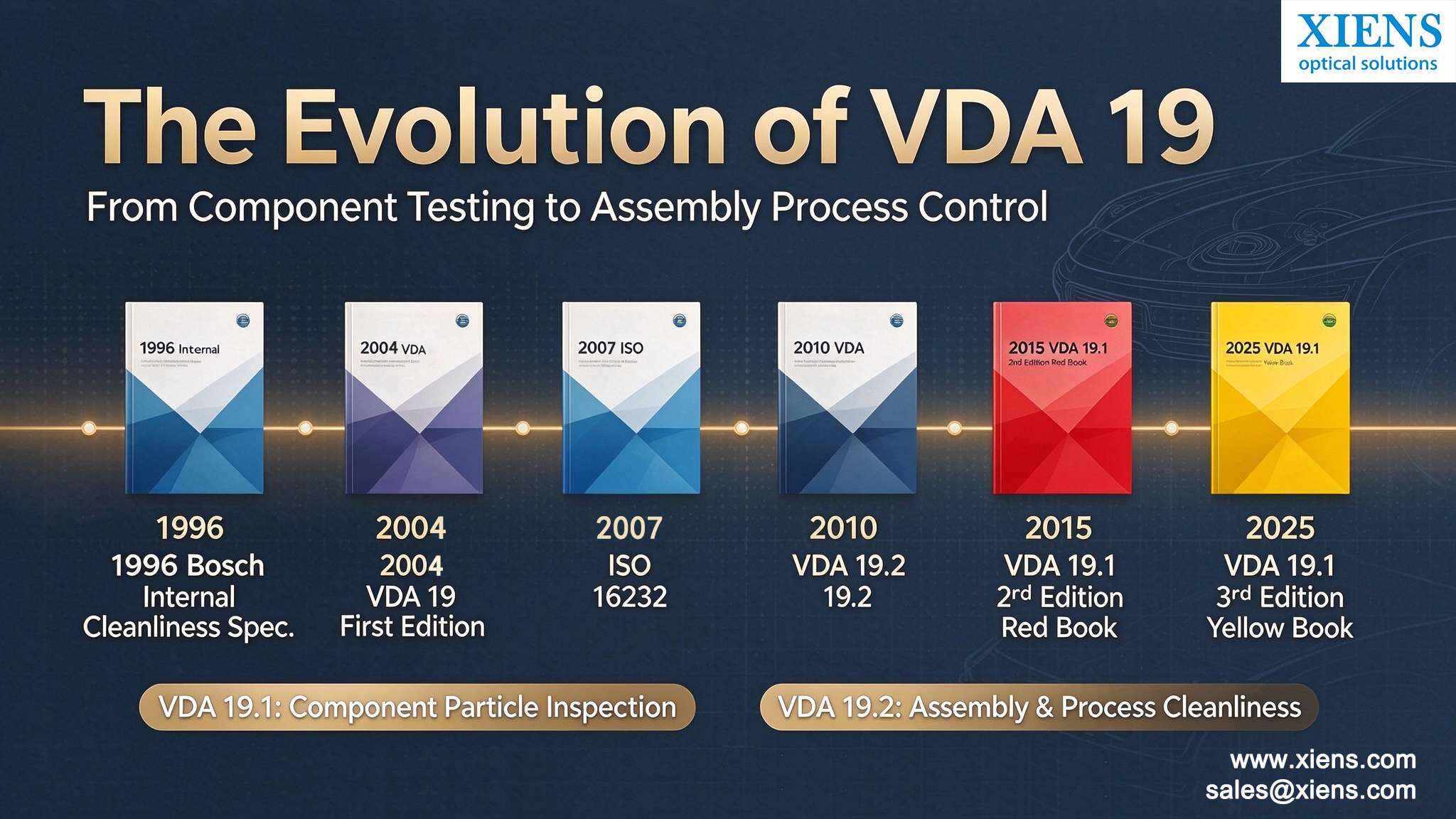
The development of VDA 19 reflects the automotive industry's growing focus on particulate contamination control and standardized cleanliness inspection.
Before 2004 – Early Industrial Cleanliness Requirements
Increasing cleanliness requirements for precision automotive components, particularly fuel injection systems, highlighted the need for systematic particulate contamination control. Industrial practices developed by companies such as Bosch contributed to the growing importance of technical cleanliness in automotive manufacturing.
2004 – First Edition of VDA 19
The first edition of VDA 19 was published by VDA, establishing a common framework for the inspection of particulate contamination in automotive components.
2007 – ISO 16232 Series Published
The ISO 16232 series was published, providing an international framework for determining particulate contamination in road vehicle components and systems. It shared closely aligned technical cleanliness principles with VDA 19.
2010 – Introduction of VDA 19.2
VDA 19.2 was introduced to extend technical cleanliness requirements beyond laboratory testing. It focused on contamination prevention in assembly environments, personnel, equipment, handling and logistics.
2015 – VDA 19.1 Second Edition
The second edition of VDA 19.1 was released, refining laboratory inspection procedures and providing more comprehensive technical guidance. It became a widely used reference for automotive suppliers, testing laboratories and precision component manufacturers.
2018 – ISO 16232:2018 Published
ISO 16232 was consolidated and revised into a single international standard, replacing the previous multi-part 2007 series. The updated standard provided a unified framework for cleanliness inspection and reporting in the automotive industry.
July 2025 – VDA 19.1 Third Edition Yellow Volume
The third revised edition of VDA 19.1 was released in its Yellow Volume version, presenting updated technical requirements and providing an opportunity for industry feedback.
February 2026 – Official Publication of VDA 19.1 Third Revised Edition
The final third revised edition of VDA 19.1 was officially published. The revision introduced new dry extraction methods, more detailed procedures for evaluating particles smaller than 50 μm, and a standardized SEM/EDX analysis approach with uniform material classifications.
Although both belong to the VDA 19 guideline series, VDA 19.1 and VDA 19.2 address different stages of technical cleanliness management.
VDA 19.1 focuses on determining the particulate contamination present on automotive components. It provides guidance on laboratory inspection procedures, including:
Particle extraction from component surfaces and internal passages.
Filtration and preparation of extraction membranes.
Gravimetric measurement of particulate contamination.
Particle sizing, counting and morphological evaluation.
Material identification using techniques such as SEM/EDX.
The results help manufacturers evaluate component cleanliness, verify inspection requirements and support incoming and outgoing quality control.
VDA 19.2 focuses on maintaining cleanliness throughout manufacturing and assembly processes. Its purpose is to prevent contamination from being introduced after components have been cleaned or inspected.
Key areas include:
Cleanliness requirements for production and assembly environments.
Personnel clothing and handling practices.
Cleaning and maintenance of tools and assembly equipment.
Packaging, storage and transportation conditions.
Contamination prevention throughout the production and logistics chain.
In simple terms, VDA 19.1 determines how clean a component is through laboratory inspection, while VDA 19.2 addresses how cleanliness is maintained during manufacturing and assembly.
VDA 19 and ISO 16232 are closely related technical cleanliness guidelines used in the automotive industry. Both address the evaluation of particulate contamination on functionally relevant components and systems.
ISO 16232 establishes an international framework for cleanliness inspection, including test methods, documentation and standardized reporting of results. VDA 19 provides complementary guidance, with VDA 19.1 focusing on laboratory inspection and VDA 19.2 addressing cleanliness during assembly.
Although their technical principles are broadly aligned, the two documents should not be regarded as identical or interchangeable in every application. Automotive manufacturers may specify additional inspection procedures, reporting requirements or acceptance criteria based on their own quality standards.
An important distinction is that ISO 16232 does not establish universal particle contamination limits for individual components. Required cleanliness levels must be determined according to component functions, operating conditions and customer specifications.
As of November 2026, ISO 16232:2018 remains the published current edition. A revised draft, ISO/DIS 16232, entered the international enquiry stage in October 2026 and is still under development.
The third revised edition of VDA 19.1 represents an important update to laboratory technical cleanliness inspection. Its revision reflects years of practical experience in cleanliness laboratories, advances in analytical techniques and the increasing requirements of modern automotive manufacturing.
The major updates include:
1. New Dry Extraction Methods
The revised guideline incorporates additional dry extraction methods to expand the available options for removing particulate contamination from component surfaces and internal areas. These methods complement established wet extraction procedures and provide more flexibility for different component geometries and inspection requirements.
2. More Detailed Evaluation of Particles Smaller Than 50 μm
The third edition provides more precise guidance for inspecting and evaluating particles below 50 μm. This is particularly relevant to precision components where smaller particles may still affect functional performance and reliability.
3. Standardized SEM/EDX Analysis
The revised guideline introduces a standardized SEM/EDX analysis approach with uniform material classifications. This helps improve consistency in particle material identification and makes analytical results more comparable between laboratories.
4. More Flexible Inspection Procedures
The revised edition maintains standardized analysis procedures to support comparable test results while allowing problem-specific inspections under defined requirements. This provides greater flexibility when investigating particular contamination issues or evaluating specialized components.
5. Improved Testing Procedures and Technical Guidance
Based on practical experience from cleanliness laboratories, the third edition includes numerous clarifications and optimizations to testing procedures and starting parameters. These improvements help laboratories establish more consistent inspection workflows and document their results more effectively.
Overall, the updated VDA 19.1 provides a more detailed framework for laboratory cleanliness inspection and supports its application in quality assurance, engineering, product development and supplier management.
From the early industrial cleanliness requirements of the automotive industry to the latest VDA 19.1 third revised edition published in 2026, technical cleanliness has evolved into an essential aspect of automotive quality management.
The development of VDA 19.1, VDA 19.2 and ISO 16232 reflects the industry's growing demand for reliable particulate contamination inspection and effective contamination prevention throughout manufacturing and assembly.
As automotive technologies continue to advance, particularly in electric vehicles, hydraulic systems and precision fluid components, standardized technical cleanliness inspection will remain important for product reliability, manufacturing quality and supplier qualification.
1. Which edition of VDA 19.1 is currently the latest?
The third revised edition of VDA 19.1 was officially published in February 2026. It replaces the 2015 second edition as the latest edition of the guideline. However, the applicable version for individual projects depends on customer requirements and contractual specifications.
2. Do manufacturers need to follow both VDA 19.1 and VDA 19.2?
Not necessarily in every application. VDA 19.1 and VDA 19.2 address different aspects of technical cleanliness management. VDA 19.1 focuses on laboratory inspection, while VDA 19.2 focuses on cleanliness control during assembly. Automotive OEMs and suppliers may require one or both depending on their quality management requirements.
3. Is VDA 19 only applicable to fuel injection systems?
No. Although fuel injection systems were among the important drivers behind the development of automotive cleanliness requirements, VDA 19 is now referenced across a much broader range of applications, including hydraulic valves, braking systems, precision fluid components and other functionally relevant automotive parts.
4. What is the difference between VDA 19 and ISO 16232?
Both address particulate contamination inspection in automotive components. ISO 16232 provides an international framework for cleanliness inspection and reporting, while VDA 19.1 and VDA 19.2 provide guidance on laboratory inspection and cleanliness control during assembly. Their requirements are closely aligned, but individual customer specifications may introduce additional requirements.
Please contact us for further inquiries or detailed information!
Tel:+86-13400008098
Email:sales@xiens.com
Web:www.xiens.com



 IPv6 network supported
Leave A Message
Scan to Wechat :

Scan to Whatsapp :

 English
 Français
 Русский
 Español
 Português
 عربي
 Get A Quote