What Is the Principle of Pressure Rinsing in Technical Cleanliness Testing, and When Is It Used?
Overview
Pressure rinsing is one of the commonly used particle extraction methods in technical cleanliness testing. It uses a cleaning liquid delivered at a controlled pressure and flow rate to rinse component surfaces and internal passages, channels, and cavities that can be effectively reached by the liquid flow. This process dislodges adhering or trapped particles and carries them into the extraction liquid. The liquid is then filtered, and the collected particles are analyzed to evaluate component cleanliness.
This method is particularly suitable for valve bodies, pump housings, hydraulic components, pipelines, liquid cooling components, and other parts with deep holes, blind holes, and complex internal structures. Compared with wiping methods that primarily target accessible external surfaces, pressure rinsing uses a controlled liquid flow to reach areas that are difficult to access directly, enabling the extraction of internal particulate contaminants.
It is important to note that pressure rinsing is not the same as high-pressure surface spraying. Pressure rinsing focuses on extracting particles from defined test areas using a controlled liquid flow. It can target accessible external surfaces and internal regions that the liquid can effectively reach, whereas spray rinsing generally focuses more on cleaning external surfaces. For components with internal passages, the inlet, outlet, and rinsing paths must be appropriately designed according to the component structure.
During testing, rinsing pressure, flow rate, rinsing duration, cleaning liquid cleanliness, filtration conditions, and background contamination from the equipment can all affect the final results. Therefore, pressure rinsing is not simply a cleaning operation. It is an important particle extraction step that requires standardized control in technical cleanliness testing.
As automotive components, new energy vehicles, hydraulic systems, precision machinery, and fluid control equipment continue to evolve toward higher precision, miniaturization, and greater structural complexity, microscopic particles remaining inside components have attracted increasing attention from manufacturers. In components such as valve bodies, pump housings, pipelines, and liquid cooling assemblies, even small particles can interfere with fluid control, block narrow passages, or cause wear to critical moving parts.
Therefore, reliable technical cleanliness testing requires more than evaluating particle quantity, size, and morphology. Extracting residual particles from component surfaces and internal structures thoroughly and consistently is equally important for obtaining reliable test results.
Pressure rinsing is one particle extraction method used to meet this testing requirement. It uses a cleaning liquid delivered at a controlled pressure and flow rate to rinse component surfaces, internal passages, cavities, and channels. This allows adhering or trapped particles to be dislodged and transferred into the extraction liquid for subsequent filtration and particle analysis.
What Is Pressure Rinsing?
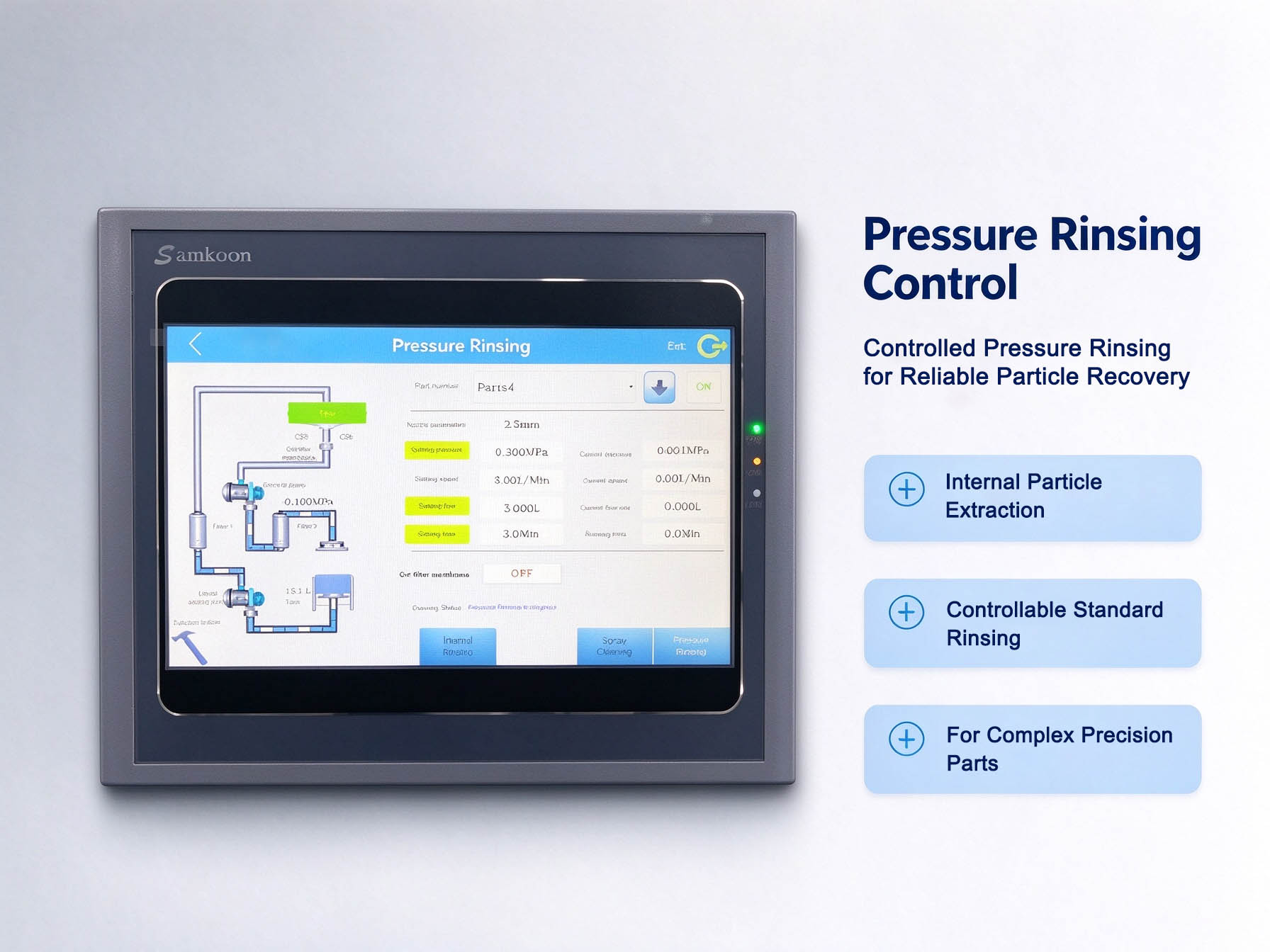
Pressure rinsing is a technical cleanliness testing method that uses a controlled, pressurized cleaning liquid to rinse a component and extract particulate contaminants.
During testing, the cleaning liquid is directed through or onto the target area at a specified pressure, flow rate, direction, and duration. The resulting impact and shear forces act on the component's external surfaces and accessible internal structures. Particles adhering to the surfaces are dislodged and carried by the liquid into a collection system.
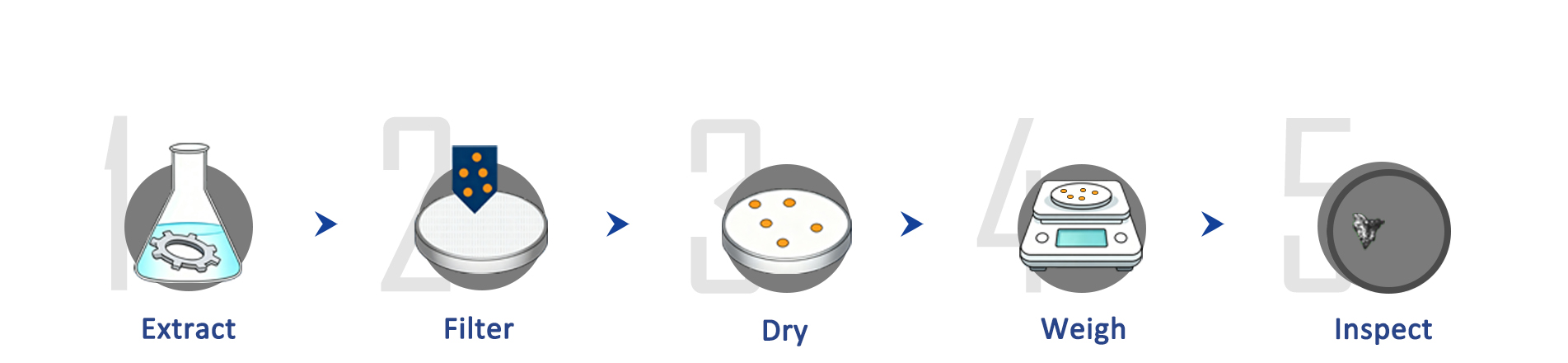
After filtration, the particles are retained on a filter membrane. Depending on the testing requirements, they are then analyzed using a microscope or an optical particle analysis system, such as an automated filter membrane scanning microscope.
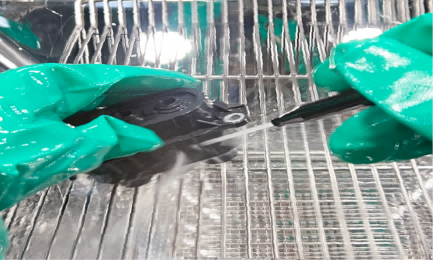
The process can be summarized as follows:
Component → Pressurized Liquid Rinsing → Particle Release → Liquid Collection → Membrane Filtration → Particle Analysis → Cleanliness Evaluation
Unlike direct inspection of a component's surface, pressure rinsing does not primarily rely on observing particles on the component itself. Its core principle is controlled particle extraction, transferring contaminants from areas that may be difficult to access directly onto a filter membrane for subsequent quantitative analysis.
It is important to distinguish automated filter membrane scanning microscopy, an optical microscopy method based on imaging particles collected on a filter membrane, from a liquid particle counter (LPC), which counts particles suspended in a liquid directly. These methods differ in their measurement principles and sample preparation procedures.
What Is the Working Principle of Pressure Rinsing?
The key principle of pressure rinsing lies in the mechanical interaction between the cleaning liquid and the particles.
When the liquid flows through or over a component at a controlled pressure and flow rate, it creates fluid motion across the component's surfaces, holes, and internal passages. The impact and shear forces generated by the flowing liquid can dislodge particles adhering to surfaces or deposited within internal structures, carrying them into the collection system.
For components with deep holes, blind holes, and narrow passages, pressure rinsing can extract particles from areas that are difficult to reach using conventional wiping methods, provided that the cleaning liquid can effectively access those areas. This can improve the extraction of internal contaminants.
However, higher pressure is not always better. During actual testing, parameters such as rinsing pressure, flow rate, rinsing duration, cleaning liquid type, and rinsing direction must be selected according to the component's structure, material, and testing requirements.
If the rinsing conditions are too mild, some particles may not be adequately released. If the conditions are too aggressive, the process may dislodge material fragments that were originally firmly attached or even affect thin-walled components, seals, or delicate structures. This can alter the extraction conditions and increase uncertainty in the test results.
Therefore, establishing stable and repeatable rinsing conditions is essential for obtaining reliable technical cleanliness results.
Why Is Pressure Rinsing Suitable for Complex Components?
Traditional particle extraction methods, such as manual wiping or direct visual inspection, have certain limitations when dealing with complex internal structures.
For example, a hydraulic valve body with multiple internal passages and small-diameter holes may contain contaminants in internal channels, cavities, or connection areas. Wiping only the external surfaces cannot adequately extract particles from these internal locations.
Pressure rinsing uses a controlled liquid flow to reach accessible internal regions, dislodge contaminants, and carry them out for centralized collection and analysis.
Therefore, pressure rinsing is particularly valuable for components with complex internal structures when the extraction liquid can effectively reach the areas of interest.
Automotive Components
Automotive fuel systems, braking systems, hydraulic control systems, and other fluid control components often contain passages, valve cavities, and internal flow paths. Residual particles in these components may interfere with valve movement, fluid control, or overall system reliability. Effective extraction and analysis of internal particles are therefore important.
New Energy Vehicle Thermal Management and Liquid Cooling Components
With the development of thermal management systems for new energy vehicles, particulate contamination in cold plates, cooling pipelines, valve bodies, and other thermal management components has attracted increasing attention.
Components with microchannel structures are particularly sensitive to particle size and quantity because of their small internal dimensions. Pressure rinsing can be used to extract residual particles from these components, providing samples for subsequent analysis of particle quantity, size, and morphology.
Hydraulic and Pneumatic Components
Hydraulic valves, pump housings, valve blocks, pipelines, and fittings often contain complex internal passages. Metal chips, abrasive particles, and other contaminants generated during manufacturing may remain inside these passages and enter the system with the working fluid.
Consequently, extracting internal particles is an important part of technical cleanliness testing for these components.
Precision Mechanical Parts
Precision mechanical parts may contain deep holes, blind holes, narrow gaps, or complex cavities that are difficult to access using manual methods. Pressure rinsing uses liquid flow to extract particles from internal structures that the liquid can effectively reach, allowing the contaminants to be collected for further analysis.
Applicability and Limitations
Pressure rinsing is not suitable for every type of component. For porous materials, coatings that may flake off, fragile thin-walled structures, or components that could be affected by the rinsing process, the rinsing conditions should be selected carefully according to the material properties and component design. Method validation should be performed to confirm suitability.
For enclosed structures where the test liquid cannot effectively reach the target areas, particle extraction by pressure rinsing may be limited. Depending on the component design and testing objectives, alternative extraction methods or a combination of methods may be required.
How Can Reliable Test Results Be Ensured with Pressure Rinsing?
Although pressure rinsing is a particle extraction step, its operating conditions directly affect the final technical cleanliness results.
If the cleaning liquid contains particles, or if the filtration equipment, pipelines, or collection containers are contaminated, additional particles may be introduced, leading to artificially elevated results. Therefore, technical cleanliness testing must control contamination throughout the entire testing system, not just on the component being evaluated.
Control the Cleanliness of the Extraction Liquid
The cleaning liquid must be sufficiently clean to prevent particles already present in the liquid from becoming an additional source of contamination. Before formal testing, background checks can be performed to determine whether the liquid and associated system meet the required cleanliness criteria.
Control Background Contamination from Equipment and the Environment
Pipelines, nozzles, filtration devices, collection containers, and the testing environment can all introduce particles. The equipment and testing area should therefore be maintained in a clean condition, and blank tests or background measurements should be used to monitor contamination levels.
If the background particle count is high, the contamination source should be investigated rather than attributing all detected particles directly to the tested component.
Standardize Rinsing Parameters
Rinsing pressure, flow rate, duration, and direction should be defined according to the component structure and testing method and kept as consistent as possible. For the same product type, a standardized rinsing procedure improves the comparability of results across different production batches.
During method development, method validation, or investigations into uncertain extraction efficiency, extraction recovery testing can also be used to evaluate the effectiveness of the selected rinsing conditions. For example, reference particles with known quantities or characteristics can be introduced into a validation procedure, and their recovery can be assessed using the actual testing workflow. This helps determine whether the rinsing parameters can extract the target contaminants consistently and effectively.
Standardize Filtration and Particle Analysis
After rinsing, the particles in the extraction liquid must be effectively collected on a filter membrane. Membrane handling, filtration, and subsequent microscopic or automated particle analysis must be performed in a way that minimizes secondary contamination and particle loss.
Therefore, pressure rinsing is only the particle extraction stage of technical cleanliness testing, not the complete testing process. Every stage, from the cleaning liquid and rinsing equipment to filtration and particle analysis, can affect the final results.
FAQ
Q1: Which components are suitable for pressure rinsing?
Pressure rinsing is suitable for components with surfaces, passages, cavities, or internal structures that can be effectively reached by the extraction liquid. Typical applications include automotive components, hydraulic parts, pipelines, valve bodies, and thermal management components used in new energy vehicles.
For porous materials, coatings that may flake off, fragile thin-walled structures, and components whose target areas are difficult for the liquid to reach, the rinsing conditions should be selected carefully according to the component design and testing requirements. Method validation should be performed to confirm suitability.
Q2: Which parameters must be controlled during pressure rinsing?
The main parameters include cleaning liquid cleanliness, rinsing pressure, flow rate, rinsing duration, rinsing direction, filtration conditions, and background contamination in the testing environment.
During method development or validation, extraction recovery testing can also be used to evaluate the effectiveness of the rinsing conditions. Standardized control of these parameters helps improve extraction efficiency and the repeatability of test results.
Q3: How is component cleanliness evaluated after pressure rinsing?
After rinsing, the extraction liquid is filtered to retain the particles on a filter membrane. The particles are then analyzed using a microscope or an automated filter membrane scanning microscope to evaluate parameters such as particle quantity, size, and morphology. The results are assessed against the applicable technical cleanliness requirements to determine whether the component meets the specified cleanliness criteria.

 English
 Français
 Русский
 Español
 Português
 عربي
 Get A Quote




 IPv6 network supported