What Liquid Is Used for Technical Cleanliness Extraction?
Quick Summary
In technical cleanliness testing per ISO 16232 and VDA 19.1, extraction liquid is used to elute particulate contaminants from component surfaces. Selection of extraction liquid directly determines particle recovery efficiency and test accuracy. No universal extraction medium exists; selection shall be made comprehensively based on component material, contaminant type and extraction method. Applicability verification including blank test and particle spike recovery test is mandatory after medium selection.
1 Classification of Common Extraction Liquids
1.1 Aqueous neutral extraction liquid (containing non-ionic surfactants)
Based on deionized water, suitable for water-based emulsions, water-soluble rust preventatives and water-soluble salt contamination.
Advantages: high safety.
Risk: inorganic salt crystals may precipitate during membrane drying, which can be misidentified as solid particles and cause biased high results; foaming shall be controlled.
Note: precision cleaners such as ZESTRON are industrial cleaning products instead of low-background dedicated extraction liquids. Blank test and recovery verification must be completed prior to use.
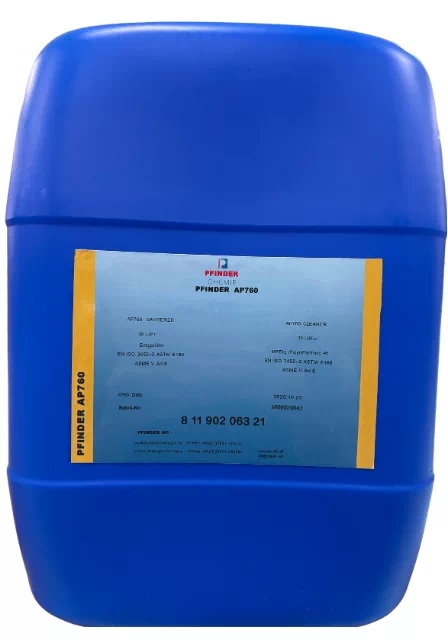
1.2 Non-polar isoparaffin solvent (most widely used for oily automotive parts, e.g. PFINDER AP760)
VDA 19.1 recommends C10–C13 isoparaffin mixture: aromatic content <2%, flash point >60°C, boiling range 180–220°C. Based on like-dissolves-like principle, it dissolves mineral cutting oil, rust preventatives and grease, applicable to oil-laden parts such as engine, transmission and hydraulic valve bodies.
Distinction: AP760, AP-PURE7060, Inflo, Hengst, HYDAC are pre-filtered low-background finished extraction liquids and can be used directly for testing. Exxsol D60/D80, ShellSol, Isopar L/M are industrial raw solvents. Although their chemical composition meets requirements, they carry high inherent particle background. They cannot be used directly for testing and shall undergo ultra-fine filtration plus full verification.
1.3 Polar solvents (IPA / Ethanol, only for special applications)
Suitable for minor organic residues and precision electronic parts.
Risk: may swell certain plastics and elastomers; fast evaporation leads to solvent concentration and re-adsorption of particles, reducing recovery rate. Not for use as universal extraction liquid; not recommended for parts with heavy mineral oil contamination.
2 Contaminant vs Extraction Liquid Selection Guide
|
Main Contaminant
|
Preferred Extraction Medium
|
Typical Components
|
|
Water-soluble salts, water-based emulsions
|
Aqueous neutral extraction liquid
|
Machined metal parts
|
|
Mineral oil, cutting oil, rust preventative
|
Low-background C10-C13 isoparaffin (non-polar solvent)
|
Engine, transmission, hydraulic components
|
|
Silicone oil
|
Low-background C10-C13 isoparaffin
|
Seals, mechanical assemblies
|
|
Minor organic residues
|
IPA / Ethanol polar solvent
|
Electronic precision parts
|
3 Key Points for Brand Selection
ISO 16232 and VDA 19.1 do not specify official brands, only medium performance requirements. Customer specifications of OEMs take precedence over base standards; some German OEMs mandate fixed extraction liquid models.
· Finished extraction liquids: PFINDER AP760, AP-PURE7060; domestic brands Inflo; dedicated isoparaffin extraction liquids from Hengst and HYDAC; PFINDER AP580 for aqueous type.
· Industrial raw solvents: Exxsol, ShellSol, Isopar series, only as raw materials and not directly for testing.
4 Selection for Conventional Automotive and New Energy Components
For engine, transmission and hydraulic parts of conventional fuel vehicles with oil contamination, low-background isoparaffin is preferred. For new-energy e-drive, reducer, valve body and thermal management components: select isoparaffin for cutting/assembly oil residues; select aqueous neutral extraction liquid if dominated by water-based machining fluid contamination. Internal cavity parts (cold plates, pipelines, manifolds) shall use recirculating flushing or pressure rinsing to ensure full contact of extraction liquid with internal flow passages.
Conclusion
Extraction liquid selection is essentially matching of contaminant, component material, extraction liquid and extraction method. For general automotive components, aqueous neutral medium or low-background C10-C13 isoparaffin is preferred; IPA/ethanol shall be evaluated for special parts. Final medium confirmation must pass blank test and spike recovery test, meanwhile considering material compatibility, background particles, safety and hazardous waste management.
FAQ
1. Can IPA be used directly for cleanliness testing?
It is only suitable for specific parts and contaminants and shall not be used as universal extraction liquid. Not recommended for parts with heavy mineral oil contamination. Before use, evaluate swelling risk of plastics/rubbers and recovery deviation caused by solvent evaporation and concentration.
2. Can extraction liquid be reused?
Reuse is permitted under VDA 19.1 base standard, but many OEM specifications prohibit reuse. If reuse is approved, filtration control and periodic blank tests are required. The liquid shall be discarded immediately once particle background exceeds limit or solvent is saturated with oil contamination.

 English
 Français
 Русский
 Español
 Português
 عربي
 Get A Quote




 IPv6 network supported