What Is ISO 16232 Technical Cleanliness Standard?
Overview
In modern automotive manufacturing and high-end equipment industries, technical cleanliness has become a critical quality indicator affecting component performance, reliability, and service life. With the continuous development of high-pressure common rail systems, precision hydraulic components, and new energy vehicle battery, motor, and electronic control systems toward higher integration and precision, micron-level to sub-millimeter residual particle contamination can lead to component sticking, abnormal wear, leakage, electrical short circuits, or even system failure.
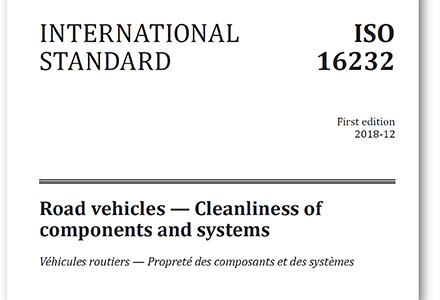
ISO 16232 “Road vehicles — Cleanliness of components and systems” is an important international standard used in the automotive industry for technical cleanliness evaluation. It provides a standardized framework for detecting residual particles in automotive components and systems. Through controlled extraction, filtration, particle analysis, and standardized result reporting, manufacturers can quantify contamination levels, identify contamination sources, optimize cleaning processes, and establish cleanliness requirements throughout the supply chain.
This article introduces the development of ISO 16232:2018, the key cleanliness testing procedures, particle extraction and analysis methods, cleanliness result expression, and its applications in automotive, new energy vehicle, hydraulic, and precision manufacturing industries. It helps manufacturers, testing laboratories, and component suppliers better understand the fundamental requirements of technical cleanliness testing.
1. Development of ISO 16232 and Comparison with Related Standards
1.1 From ISO 16232:2007 Multi-Part Structure to ISO 16232:2018
The original ISO 16232:2007 adopted a multi-part structure consisting of Part 1 to Part 10. These parts separately covered terminology, extraction methods, filtration procedures, particle analysis, and result reporting related to component cleanliness testing.
This separated structure allowed each testing procedure to be described in detail. However, in practical applications, users often needed to refer to multiple parts simultaneously, which increased complexity when laboratories established complete testing procedures or companies developed internal cleanliness specifications.
ISO 16232:2018 reorganized and integrated the original standard system. The new version places definitions, sample handling, contaminant extraction, particle collection, analysis methods, and result expression into a more coherent technical framework.
The revision was not simply a combination of the previous ten parts. Instead, it reorganized the testing logic and technical requirements to better meet the needs of modern automotive component cleanliness evaluation.
From a practical testing perspective, ISO 16232:2018 focuses on one fundamental question:
How can representative residual contaminants be effectively extracted from a component without changing its original condition, and how can these contaminants be quantitatively evaluated using repeatable analysis methods?
Therefore, technical cleanliness testing is not simply “washing a component and counting particles.” It is a complete evaluation process involving extraction method validation, contaminant collection, particle analysis, data evaluation, and quality control.
1.2 Relationship Between ISO 16232 and VDA 19.1
In the automotive industry, ISO 16232 and VDA 19.1, published by the German Association of the Automotive Industry (VDA), are two commonly referenced specifications for technical cleanliness management.
Both standards share similar principles regarding:
· technical cleanliness evaluation;
· particle extraction;
· contaminant analysis;
· particle size assessment;
· cleanliness result reporting.
Therefore, they are frequently discussed together in automotive supply chains.
However, ISO 16232 and VDA 19.1 are not identical standards.
ISO 16232 belongs to the international standard system, while VDA 19.1 is an industry guideline developed by the German automotive association. Differences may exist in specific testing methods, equipment requirements, validation procedures, and engineering application details.
Therefore, it is not correct to simply assume that:
“Compliance with ISO 16232 automatically means compliance with VDA 19.1.”
In practical projects, automotive OEMs or customers usually specify the required standard and testing conditions through drawings, technical agreements, cleanliness specifications, or inspection requirements.
When establishing a cleanliness testing process, laboratories and suppliers should first determine the applicable standard and testing parameters according to customer requirements.
2. Core Technical Cleanliness Testing Process According to ISO 16232:2018
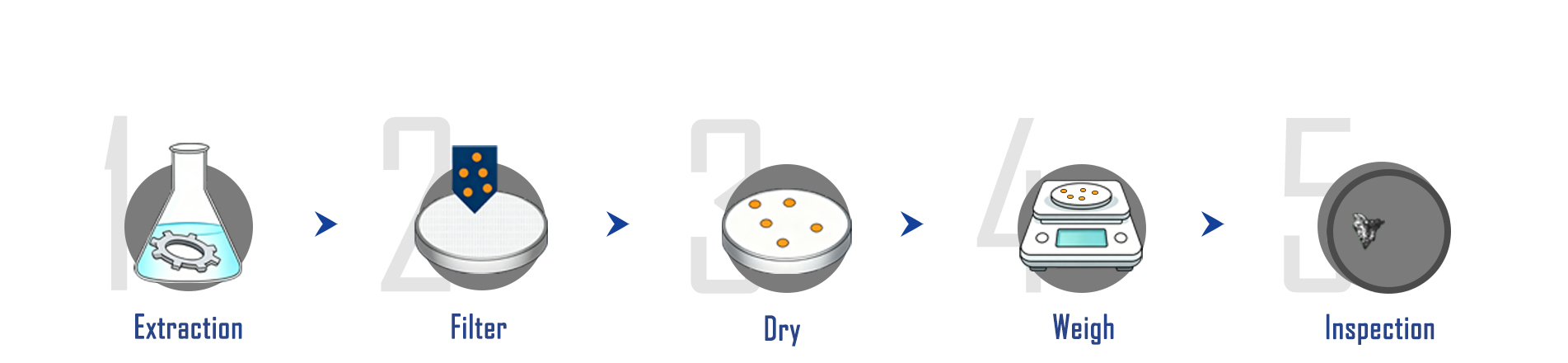
ISO 16232 technical cleanliness testing can be understood through three major technical stages:
Particle Extraction → Particle Analysis → Result Expression
In actual laboratory procedures, filtration and particle collection are located between extraction and analysis and play an essential role in ensuring accurate test results.
The objective of the entire process is not simply to obtain a “particle count,” but to establish a representative relationship between contaminants existing on a component and the final analytical data.
Therefore, the following factors directly affect the final cleanliness result:
· effectiveness of the extraction method;
· control of blank contamination;
· stability of filtration procedures;
· validation of the particle analysis system.
2. ISO 16232:2018 Technical Cleanliness Testing Process
ISO 16232 technical cleanliness testing mainly includes four key steps:
Particle Extraction → Filtration → Particle Analysis → Result Reporting
The purpose is not simply to count particles, but to obtain representative contamination data from components through a controlled and repeatable testing process.
The accuracy of cleanliness results depends on several factors, including:
· extraction method selection;
· contamination control during testing;
· filtration procedure;
· particle analysis method.
2.1 Particle Extraction Methods
Particle extraction is the first and one of the most important steps in ISO 16232 testing. Its purpose is to remove mobile contaminants from component surfaces, internal cavities, and channels, and collect them on a filter membrane for analysis.
The extraction method should be selected according to component structure, material characteristics, contamination location, and customer requirements.
Common extraction methods include:
Pressure Rinsing
Pressure rinsing uses controlled liquid pressure and flow to remove particles from component surfaces or internal passages.
It is commonly used for:
· hydraulic components;
· valve bodies;
· pump housings;
· pipelines;
· automotive parts with internal channels.
The pressure, flow rate, rinsing time, and direction should be controlled to ensure repeatable results.
Ultrasonic Extraction
Ultrasonic extraction uses cavitation effects to improve particle removal efficiency and is suitable for small or complex components where contaminants are difficult to remove by conventional methods.
However, excessive ultrasonic energy may damage surfaces or coatings and introduce additional particles. Therefore, ultrasonic parameters should be validated according to component characteristics.
Internal Flushing and Air Extraction
For components with complex internal structures, such as fluid control parts and pipelines, internal flushing or circulation extraction can help remove hidden contaminants inside channels.
For components unsuitable for liquid cleaning, such as some electronic assemblies or dry components, controlled air extraction may be used to collect released particles.
2.2 Extraction Validation and Contamination Control
Before routine testing, the extraction method should be validated to confirm that it can effectively remove removable contaminants without generating artificial particles.
A commonly used validation method is the Decay Test, where the same component is extracted multiple times. When the amount of extracted contamination gradually decreases and reaches a stable level, the extraction condition can be considered appropriate.
In addition, Blank Value Control is essential in technical cleanliness testing. Background contamination may come from:
· laboratory environment;
· cleaning fluids;
· filter membranes;
· equipment;
· containers;
· operator handling.
Controlling blank contamination ensures that the final cleanliness result represents the component itself rather than the testing process.
3. Particle Analysis Methods in ISO 16232
After extraction, the contaminated liquid is filtered and particles are collected on a filter membrane. Different analysis methods can then be selected according to cleanliness requirements.
3.1 Gravimetric Analysis
Gravimetric analysis measures the total mass of collected contaminants by comparing the weight difference of the filter membrane before and after filtration.
Typical results include:
· mg/component;
· mg/1000 cm².
This method provides an overall contamination level but cannot identify individual particle size, quantity, or morphology.
3.2 Automated Microscopy Analysis
Automated optical microscopy is widely used for detailed particle analysis.
The system can identify:
· particle number;
· particle size;
· particle morphology;
· particle distribution;
· reflective characteristics.
Feret Maximum Diameter is commonly used to evaluate particle size and identify critical particles that may cause blockage, wear, or functional problems.
Particles may also be classified according to optical characteristics, such as:
· reflecting particles;
· non-reflecting particles;
· fibers.
It should be noted that optical classification does not always represent actual material composition. For critical particles, further analysis may be required.
3.3 SEM/EDX Analysis for Particle Identification
When abnormal or critical particles are detected, SEM/EDX analysis can be used for further investigation.
SEM provides detailed particle morphology information, while EDX identifies elemental composition, helping determine possible contamination sources.
For example:
· Fe particles may indicate steel machining or wear;
· Al particles may come from aluminum alloy processing;
· Cu particles may relate to copper components or equipment.
SEM/EDX helps manufacturers trace contamination sources and improve manufacturing processes, but it is not a replacement for the complete ISO 16232 cleanliness testing procedure.
FAQ
Q1: What does ISO 16232 mainly test?
ISO 16232 is mainly used to evaluate the technical cleanliness of road vehicle components and systems. It uses controlled extraction methods to remove mobile contaminants from components and analyzes the collected particles based on their quantity, size, mass, and other characteristics.
Q2: Why is extraction method validation required in ISO 16232 cleanliness testing?
Because different components have different structures and materials, the same extraction method may not be suitable for all products.
If the extraction intensity is insufficient, important contaminants may not be effectively removed from the component. If the extraction intensity is excessive, it may cause abnormal particles to be generated from the component substrate, plating, or coating.
Therefore, extraction conditions need to be validated through methods such as the Decay Test, and only after confirming the stability and repeatability of the method should they be applied to routine cleanliness testing.

 English
 Français
 Русский
 Español
 Português
 عربي
 Get A Quote




 IPv6 network supported