Technical Cleanliness vs. Cleanroom Cleanliness: Core Differences for High-End Advanced Manufacturing
In cutting-edge advanced manufacturing, the performance and service life of products — ranging from engine components that determine vehicle durability to semiconductor wafers powering the digital economy — often hinge not on high-level system architectures, but on microscopic and nanoscale contaminants invisible to the naked eye. Technical Cleanliness and cleanroom cleanliness are two frequently used, easily confused core terms in quality management and process specifications.
While both target contamination control, they differ fundamentally in assessment objects, testing standards and control dimensions.
1. Technical Cleanliness vs. Cleanroom Cleanliness: Solid Surfaces vs. Ambient Space
The primary distinction lies in the physical medium being evaluated:
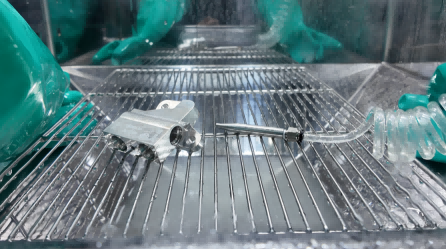
Technical Cleanliness evaluates residual contaminants on solid surfaces. It quantifies the dosage and form of residual particulate matter (metal shavings, dust), oil stains and other chemical residues left on the surfaces or internal cavities of parts, equipment and finished products after defined manufacturing processes.
- Assessment target: Contaminants (particles, fibers, metal debris, oil residues) remaining on or inside components
- Primary standards: ISO 16232, VDA 19, widely adopted in automotive and precision machinery sectors
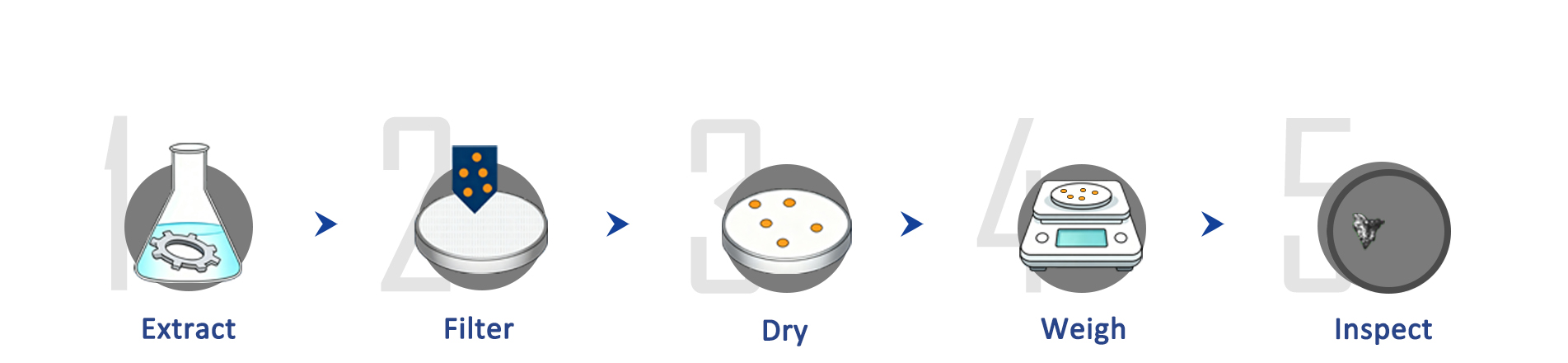
- Testing workflow: Contaminant extraction via pressure rinsing or ultrasonic extraction → particle capture on filter membranes → gravimetric weighing, microscopic particle counting (quantity & size distribution, optional material analysis)
- Test outputs: Particle count, particle size distribution, total contaminant mass, Component Cleanliness Code (CCC)
- Focus: Hard particles carried by component surfaces, to prevent abrasion of valves and bearings or blockage of oil circuits
Cleanroom Cleanliness
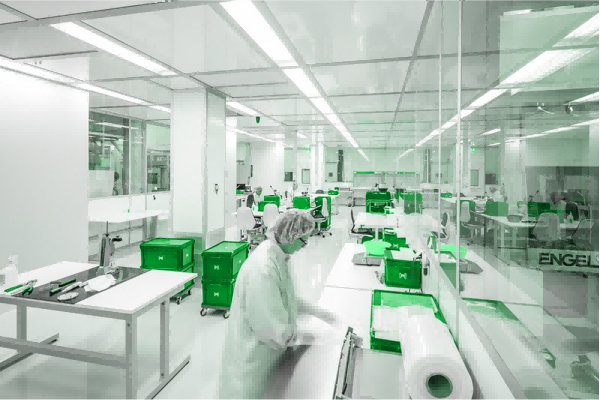
Cleanroom cleanliness measures suspended particle concentration within a medium or enclosed space. It describes the quantity and particle size distribution of airborne particles per unit volume of air, liquid or process gas inside controlled spaces such as cleanrooms.
- Assessment target: Production environments, controlled spaces, air and high-purity process media
- Primary standards: ISO 14644-1 cleanroom classification (ISO Class 5, ISO Class 7, etc.), GB 50073-2013
- Testing workflow: Air sampling with a laser light-scattering airborne particle counter for real-time statistical analysis
- Test outputs: Count of particles ≥0.5 μm and other target sizes per cubic meter of air, assigned cleanroom classification
- Focus: Ambient air quality of production spaces, stopping newly generated airborne particles from settling onto product surfaces
2. Comparison of Core Metrics
| Comparison Item |
Technical Cleanliness |
Cleanroom Cleanliness |
| Core Subject |
Solid surfaces (components, equipment, product surfaces) |
Enclosed spaces, gas or liquid media (cleanrooms, process air, high-purity gas) |
| Monitored Parameters |
Mass, quantity and size distribution of surface residual particles, oil contamination |
Quantity and size distribution of suspended particles per unit volume |
| Representative Standards |
ISO 16232 (Road vehicles — Cleanliness of components and systems), VDA 19 |
ISO 14644-1 (Cleanrooms and associated controlled environments), GB 50073-2013 |
| Test Methodology |
Pressure rinsing / ultrasonic extraction + membrane filtration (gravimetry, microscopic counting) |
Airborne particle counter (laser light scattering method) |
| Typical Applications |
Automotive components (engines, transmissions), hydraulic parts, new-energy battery components |
Semiconductor wafer fabrication, pharmaceutical clean workshops, operating rooms, optoelectronic display production |
3. Integrated Application in Industrial Workflows
Technical Cleanliness and cleanroom cleanliness do not operate independently in modern manufacturing chains; they complement each other: a high-cleanliness production environment is the foundation for delivering components meeting strict Technical Cleanliness requirements.
Semiconductor wafer fabrication facilities may run at the extreme ISO Class 1 cleanliness level (mass-production lines commonly adopt ISO Class 2–3) to suppress airborne particulate deposition. Meanwhile, wafer cleaning and packaging processes require surface inspection for micro-particles and metallic ions on wafers to guarantee reliable circuit interconnection.
The same principle applies to lithium-ion battery manufacturing. Electrode winding is carried out in dry, high-grade cleanrooms, while pole pieces and housing parts must pass rigorous Technical Cleanliness inspection before assembly to eliminate thermal runaway risks caused by metal burrs.
From component-level Technical Cleanliness inspection to cleanroom environmental classification, a solid understanding of these two indicators and their control logic lays the groundwork for refined quality management. It is also critical for high-end manufacturing to pursue zero-defect and ultra-reliable products.
FAQ
Q1: Why may failures linked to particulate contamination still occur after assembly, even if new-energy battery or auto parts pass Technical Cleanliness testing?
A: This is most often caused by secondary cross-contamination from insufficient cleanroom cleanliness. Even if components meet ISO 16232 Technical Cleanliness requirements after offline cleaning and inspection, suspended particles in uncontrolled ambient air can settle back onto component surfaces during transfer, staging and assembly if these steps are not performed within an ISO 14644-1 classified clean space.
Manufacturing sites must implement full contamination chain control covering cleaning, assembly and encapsulation. Passing Technical Cleanliness tests at a single process step cannot guarantee zero-defect final products.
Q2: How are the gravimetric method and particle counting method coordinated for quality control in VDA 19 / ISO 16232 Technical Cleanliness testing?
A: The two methods target different failure modes and should be used in combination:
Gravimetric Method: The mass difference of filter membranes before and after filtration is measured to calculate total contaminant mass (unit: mg per part). It is suited for controlling bulk coarse machining residues and total oil contamination loads from upstream processes.
Please contact us for further inquiries or detailed information!
Tel:+86-13400008098
Email:sales@xiens.com
Web:www.xiens.com

 English
 Français
 Русский
 Español
 Português
 عربي
 Get A Quote




 IPv6 network supported