How Does an AI Automatic Analysis System Improve Liquid Cooling UQD Cleanliness Testing Efficiency?
Overview
With the growing adoption of liquid cooling technology in AI data centers, cleanliness control of liquid cooling UQD (Universal Quick Disconnect) connectors has become increasingly important. Traditional manual microscopic particle analysis is time-consuming, subject to operator-dependent variations, prone to fatigue-related inspection errors, and difficult to manage in terms of data traceability. These limitations make it challenging to meet the demands of large-scale production.
XIENS AI Automatic Cleanliness Analysis System integrates optical scanning, dual-polarization imaging, and AI-based particle recognition algorithms to automate filter membrane particle analysis, providing a standardized testing solution for UQD connectors and other precision liquid cooling components.
1. Limitations of Traditional Manual Particle Analysis
Traditional cleanliness analysis relies heavily on manual microscopic observation and particle classification, presenting several challenges:
Time-consuming analysis: Manually observing and recording individual particles becomes increasingly time-consuming when particle counts are high. Large or potentially harmful foreign particles may also be overlooked.
Inconsistent particle classification: Distinguishing between metallic particles, non-metallic particles, and fibers relies heavily on operator judgment, potentially resulting in variations between inspectors.
Visual fatigue and inspection errors: Prolonged microscopic observation can cause eye strain and fatigue, increasing the risk of misclassification and missed particles.
Difficult data management: Manual recording and data consolidation require additional effort, making quality traceability and process analysis more complicated.
2. How Does the AI Automatic Analysis System Work?
The XIENS AI automatic analysis system combines optical imaging, dual-polarization technology, and intelligent particle recognition to automate filter membrane analysis.
2.1. Automatic Optical Scanning and Imaging
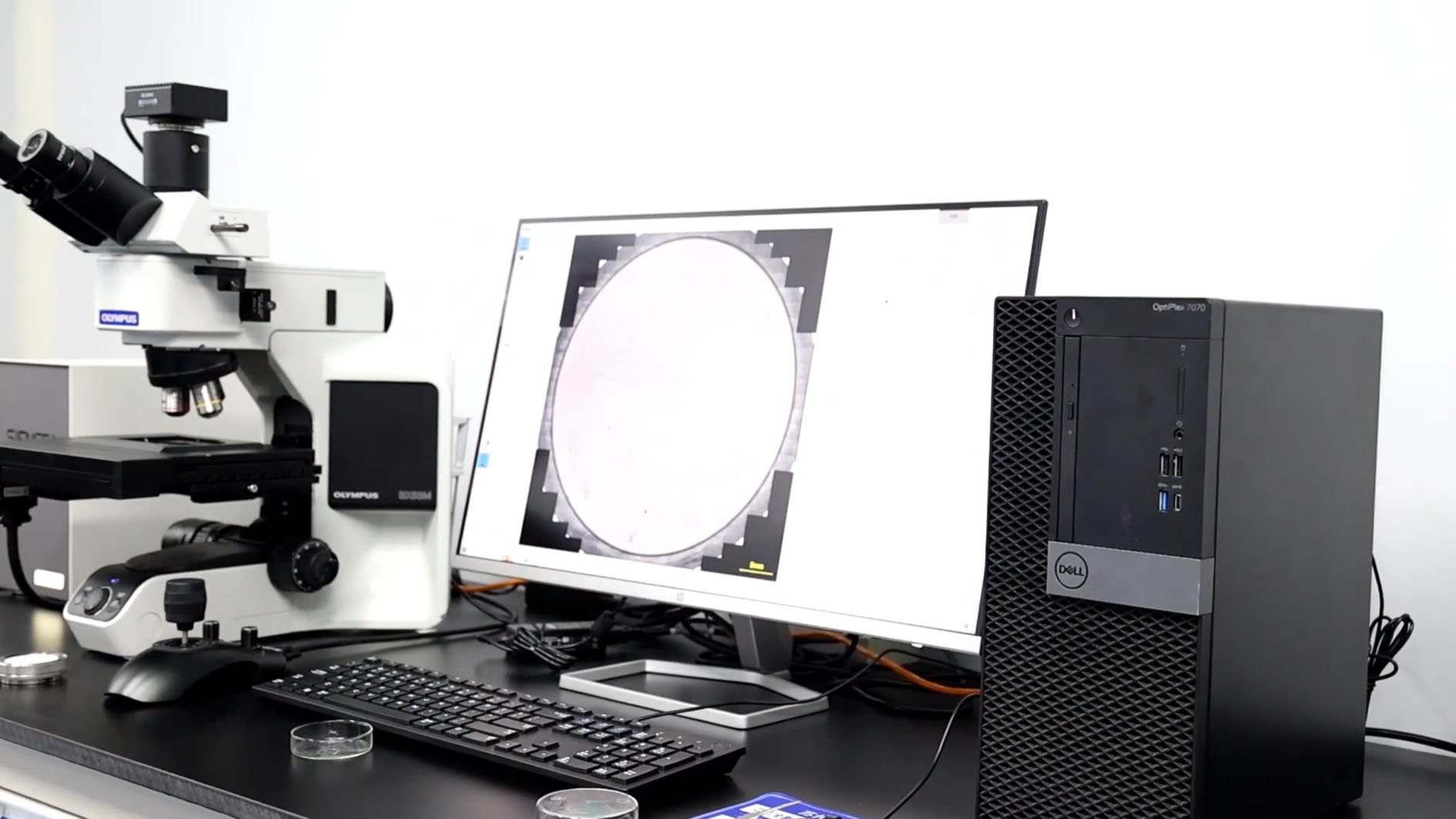
The system automatically scans the entire filter membrane and continuously captures particle images, eliminating the need for operators to manually move between microscopic fields of view.
2.2. Dual-Polarization Feature Extraction
Dual-polarization imaging captures multidimensional optical information under different polarization conditions.
Non-metallic particles and fibers may exhibit distinctive polarization characteristics, while metallic particles are generally more isotropic in their optical response. Metallic particles can also be characterized through bright-field reflection, grayscale, and morphological features. These complementary imaging characteristics provide additional inputs for AI-based particle recognition and classification.
2.3. AI-Based Particle Recognition and Classification
AI algorithms automatically identify particle boundaries and classify detected particles into three main categories:
Metallic particles
Non-metallic particles
Fibers
The system also measures the particle projected equivalent diameter (PED) and automatically generates particle statistics.
Overlapping particles and particles with complex morphologies may require manual review to confirm classification accuracy.
3. AI Automatic Analysis Workflow for UQD Cleanliness Testing
The AI analysis module is integrated into the filter membrane analysis stage of the overall UQD cleanliness testing process.
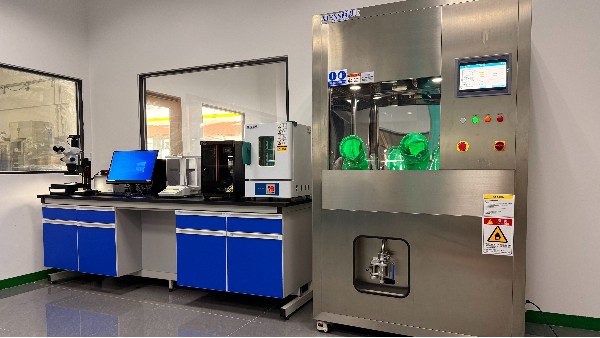
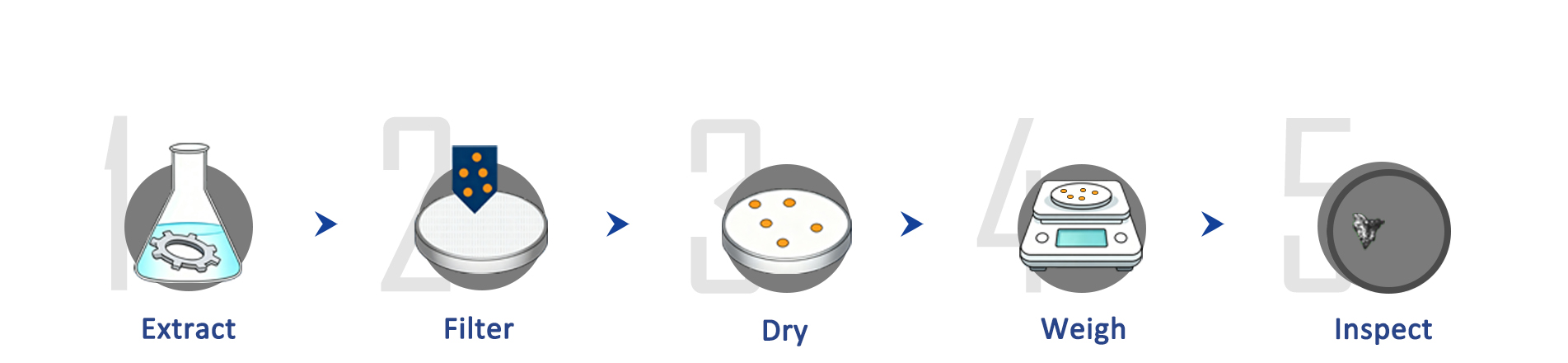
UQD pressure-rinsing extraction → Filtration and particle collection on the filter membrane → Automatic optical scanning and imaging → AI particle recognition, classification, and size measurement → Automatic testing report generation
The AI system automates the microscopic analysis of particles collected on the filter membrane. However, sample extraction, rinsing, filtration, and other sample preparation procedures must still be performed according to the applicable testing requirements.
4. What Testing Data Can the AI Analysis System Provide?
Depending on the system configuration and analysis functions, the XIENS AI automatic analysis system can provide the following information:
Total particle count: Total number of detected particles, classified by particle type and size range.
Particle size distribution: Statistical distribution of particle sizes across different size ranges.
Particle classification: Separate statistics for metallic particles, non-metallic particles, and fibers.
Maximum particle size: Maximum particle projected equivalent diameter (PED), together with its image coordinates for identification and review.
Image and data traceability: Storage of particle images, original analysis data, and testing reports for subsequent retrieval and comparison.
Important Note: Image-based particle analysis provides particle count and dimensional information but cannot directly determine particle mass. Particle mass must be measured separately using an appropriate gravimetric method, such as filter membrane weighing.
Cleanliness testing can be performed in accordance with the applicable test methods described in VDA 19.1 and ISO 16232. These standards do not establish universal cleanliness acceptance limits for all UQD products. Pass/fail evaluation must be based on the specific cleanliness requirements defined in the relevant product specifications or customer standards.
5. Data Management and Quality Traceability
The XIENS system associates and stores particle images, analysis data, and testing reports, allowing users to retrieve inspection records by production batch, product model, or testing date.
This digital data management capability supports several quality control activities:
Batch comparison: Compare particle counts, sizes, and classifications across different production batches.
Contamination source investigation: Review particle images and classification results to help identify potential contamination sources during machining, cleaning, assembly, or other manufacturing processes.
Incoming and outgoing quality control: Maintain traceable inspection records for incoming materials and finished products.
Quality trend analysis: Monitor changes in cleanliness performance over time and provide data support for process optimization.
By automating data collection and storage, the system reduces manual documentation work and improves the consistency and traceability of cleanliness testing records.
6. Supporting High-Volume Liquid Cooling Component Inspection
As production capacity for liquid cooling components continues to expand, manual microscopic particle analysis can become a bottleneck in the overall cleanliness testing process.
For manufacturers of UQD connectors and other liquid cooling components, AI-based automatic analysis reduces repetitive manual operations, improves consistency in particle identification, and increases analysis throughput.
These capabilities help manufacturers optimize inspection workflows, expand testing coverage, and strengthen process quality control to support the growing demands of large-scale liquid cooling production.
7. XIENS Liquid Cooling Cleanliness Testing Solutions
XIENS specializes in the development of industrial cleanliness testing equipment and solutions.
Its cleanliness testing systems are designed for various liquid cooling components, including UQD connectors and liquid cooling corrugated tubes. XIENS has provided equipment and testing solutions to leading companies in the liquid cooling components and fluid control industries, with products exported to multiple international markets.
In addition to equipment supply, XIENS provides comprehensive technical services, including installation and commissioning, operator training, and equipment calibration.
By integrating automated testing, AI-based particle analysis, and digital data management, XIENS helps manufacturers advance liquid cooling component cleanliness inspection toward greater efficiency, standardization, and intelligence.
Conclusion
Cleanliness testing of liquid cooling UQD connectors requires not only reliable particle extraction and filtration but also efficient and consistent particle analysis.
The XIENS AI automatic analysis system combines optical imaging, dual-polarization technology, and AI-based particle recognition to automate filter membrane scanning, particle classification, and dimensional statistics. By reducing manual analysis workload and strengthening data traceability, the system provides an efficient testing solution for the growing quality control demands of the liquid cooling industry.
FAQ
Q1: What types of particles can an AI automatic particle analysis system identify?
A: Depending on the system's algorithm model and recognition capabilities, it can automatically identify and classify metallic particles, non-metallic particles, and fibers on filter membranes. It can also measure particle dimensions and generate particle count and size distribution statistics.
Q2: Can AI automatic analysis completely replace manual microscopic inspection?
A: AI automatic analysis can significantly reduce the workload associated with manually observing, counting, and classifying individual particles, while improving inspection efficiency and result consistency. However, manual review is still recommended for overlapping particles, particles with complex or irregular morphologies, particles near filter membrane boundaries, and targets with low classification confidence to ensure reliable analysis results.
Please contact us for further inquiries or detailed information!
Tel:+86-13400008098
Email:sales@xiens.com
Web:www.xiens.com

 English
 Français
 Русский
 Español
 Português
 عربي
 Get A Quote




 IPv6 network supported