VDA 19.1 vs ISO 16232: Key Differences for Automotive Technical Cleanliness Testing
Overview
Understand the differences between VDA 19.1 (2025 3rd edition) and ISO 16232:2018 for automotive technical cleanliness, extraction methods, SEM-EDX reporting and customer compliance selection.
Introduction
Technical cleanliness is a non-negotiable quality gate for automotive, EV, hydraulic and precision components. Micron-sized particle contamination can cause valve sticking, insulation failure, battery short circuits and field warranty claims. Two dominant documents govern particulate cleanliness inspection worldwide: VDA 19.1 from VDA QMC and ISO 16232:2018, the ISO international standard.
Many suppliers mistakenly treat VDA 19.1 and ISO 16232 as fully interchangeable. While they share the same foundational testing logic, the latest VDA 19.1 (3rd edition, 2025) introduces critical new methods and mandatory rules that are not present in ISO 16232:2018. Choosing the wrong standard on your test report can lead to PPAP rejection and non-compliance with OEM specifications.
What Are VDA 19.1 and ISO 16232?
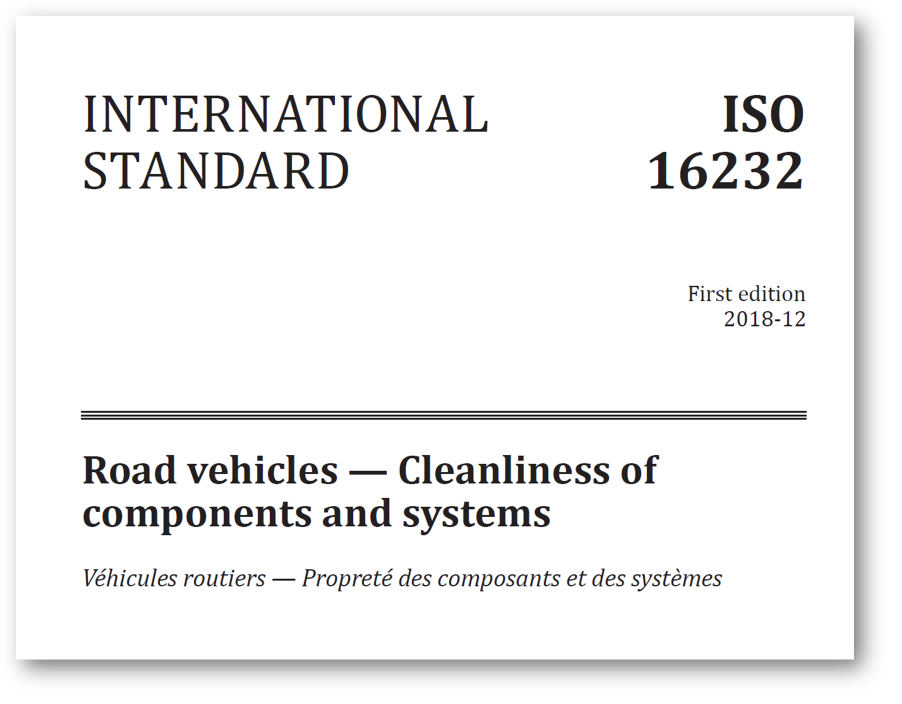
VDA 19.1: Inspection of Technical Cleanliness – Particulate Contamination of Functionally Relevant Automotive Components Issued by the German Association of the Automotive Industry (VDA QMC). It is an industry guideline widely specified by German OEMs and tier suppliers including Volkswagen, BMW, Bosch, Continental and ZF. The newest 2025 3rd edition expands the scope significantly for e-drive and battery components sensitive to liquid exposureVDA QMC.
ISO 16232:2018: Road vehicles — Cleanliness of components and systems The global ISO standard, built originally on the framework of VDA 19.1 (2015 2nd edition). It is preferred for global, non-German OEM projects, cross-border supply chains and multi-region vehicle programmes. ISO 16232:2018 merged the old 10-part series into one single document for easier adoption across marketsISO.
Both standards apply only to solid particulate contamination. Neither standard covers film-type contamination such as oil, grease or residues (those fall under VDA 19.2).
Core Similarities
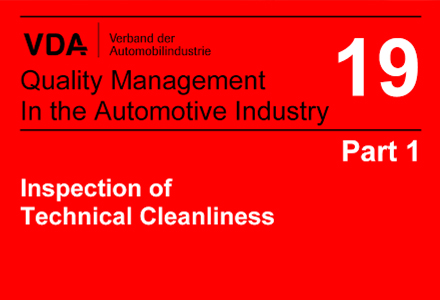
For liquid extraction workflows, the two standards remain largely aligned:
· Pressure rinsing, agitation soaking, ultrasonic extraction and bench extraction
· Gravimetric analysis, optical microscopy particle counting
· Declining test (method validation) and blank value control rules
· Component Cleanliness Code (CCC) for result classification
· Documentation requirements for lab accreditation and test certificates
If you run the same liquid extraction parameters, test results are comparable and laboratories qualified to one standard can support the shared scope.
Key Differences Between VDA 19.1 (2025) and ISO 16232:2018
1. Dry Extraction Methods (Biggest Practical Gap)
VDA 19.1 (2025): Includes two standardized dry extraction methods
· Vacuum extraction
· Stamping test
Dry methods are designed for electrical, battery, motor and sealed components that cannot be soaked or flushed with liquid. This is a major update for EV supply chains.
ISO 16232:2018: Only basic air blowing is mentioned. No standardized vacuum extraction or stamping test procedure. You cannot issue an ISO 16232 report for a stamping test or vacuum extraction run under VDA 19.1 rules.
2. SEM-EDX Particle Analysis
VDA 19.1 (2025): SEM-EDX is formally defined as standard analysis It provides unified rules for particle material classification, contamination root cause analysis and reporting of critical hard particles.
ISO 16232:2018: SEM/EDX is only an optional extended analysis. No mandatory classification scheme for particle composition.
3. Level of Detail and Fixed Starting Parameters
VDA 19.1: Written as a lab-ready operation manual. It defines fixed default starting parameters for extraction, filter selection and instrument settings. This reduces disputes between supplier, lab and OEM. It also defines clear rules for handling out-of-spec blank tests and measurement uncertainty.
ISO 16232:2018: Written as a framework international standard. Most operating parameters are open to agreement between supplier and customer. It is more flexible but leaves more room for misalignment during audits.
4. Customer & Project Fit
· VDA 19.1: German OEMs, European automotive tier 1, EV motor / battery parts requiring dry cleanliness test
· ISO 16232:2018: Global programmes, Asian / North American OEMs, general fluid component cleanliness with liquid extraction
VDA 19.1 (2025) vs ISO 16232:2018
| Comparison Item |
VDA 19.1 (2025) |
ISO 16232:2018 |
| Standard Type |
VDA automotive guideline |
International ISO standard |
| Scope |
Solid particulate contamination |
Solid particulate contamination |
| Liquid Extraction |
Standardized extraction methods |
Standardized liquid extraction methods |
| Dry Extraction |
Includes standardized vacuum extraction and stamping test methods |
Covers general air extraction but does not specify standardized vacuum extraction or stamping test methods |
| SEM-EDX |
Expanded analysis and reporting guidance |
Optional extended analysis |
| Test Parameters |
More detailed operational guidance |
More flexibility for customer agreement |
| Main Application |
German OEMs, EV and battery components |
Global automotive supply chains |
Critical Compliance Note for Suppliers
Rule: Follow exactly the standard name + version written on drawing, PO or CSR (customer-specific requirement).
Do not cross-certify: Test results generated by VDA 19.1 exclusive dry methods or formal SEM-EDX workflows cannot be relabelled as ISO 16232.
Accreditation scope: Your lab certificate must list the exact standard edition you report against.
Conclusion
ISO 16232:2018 is the universal baseline for global automotive technical cleanliness. VDA 19.1 (2025) is the more advanced, operationally detailed guideline with EV-focused dry extraction and standardized SEM-EDX particle identification.
For export suppliers, the safest quality strategy is to confirm the required standard version before sampling, define extraction method in advance and issue certificates strictly matching the customer specification.
FAQ
1.Can I use VDA 19.1 test data for ISO 16232 submission?
Only when you use the shared liquid extraction methods and the customer explicitly accepts equivalence. New VDA 19.1 dry extraction and standardized SEM-EDX are not covered by ISO 16232:2018.
2.Which standard is better for lithium-ion battery components?
VDA 19.1 (2025 3rd edition) is more suitable because it formalizes dry extraction techniques that avoid exposing sensitive cells and insulation materials to test fluids.
Please contact us for further inquiries or detailed information!
Tel:+86-13400008098
Email:sales@xiens.com
Web:www.xiens.com

 English
 Français
 Русский
 Español
 Português
 عربي
 Get A Quote




 IPv6 network supported