In which fields can technical cleanliness extraction equipment be applied?
In which fields can technical cleanliness extraction equipment be applied?
Cleanliness extraction equipment separates and purifies target substances via physical/chemical methods, which can efficiently extract and collect particulate contaminants from the surface of the tested workpiece onto a filter membrane, completing the cleaning and sample preparation processes simultaneously and significantly improving detection efficiency.

Application Fields of Technical Cleanliness Extraction Equipment
1. Automobile Manufacturing: This equipment is a standard configuration for quality control in the industry, covering impurity extraction for precision components including engines, gearboxes and brake systems.
2. Aerospace: It is compatible with the inspection of components such as hydraulic pipelines and servo valves, and complies with relevant industry standards. It can prevent hydraulic system jamming caused by tiny impurities, thus guaranteeing the operational safety of equipment.
3. Semiconductors: It is applied to impurity extraction for precision parts such as wafer carriers, lithography components and packaging welding heads. The whole process is completed in a Class 100 cleanroom to avoid introducing additional impurities, which directly guarantees the yield of wafer production.
4. Environmental Monitoring: It can accurately extract pollutant components from water samples, air and soil, providing reliable test sample support for environmental quality assessment and pollution source tracing.
5. Food and Pharmaceutical: It is used for purity screening of food raw materials and impurity detection in pharmaceutical production processes, ensuring product safety and compliance and meeting industry quality control requirements.
6. Other Extended Fields: It is also widely used in scenarios such as precision hardware processing, chemical material analysis and scientific research laboratories, and can adapt to various high-precision sample pretreatment requirements.
Potential Future Development Areas
Automation Integration: Unmanned full-process operation covering robotic loading/unloading, automated extraction, automated filtration and automated analysis
Online Monitoring: Real-time particle counting and in-process quality control
Upgraded Microanalysis: Synchronous acquisition of composition, morphology and size of individual particles via coupled SEM-EDS
Digital Management: LIMS system integration enabling full life-cycle traceability of cleanliness data
Green Solvents: Application of environmentally friendly and safe green solvents
AI Assistance: Machine learning-based identification of particle sources and intelligent determination of pollution causes
FAQ
Q1: Why do traditional manufacturing sectors such as automotive and aerospace have such stringent requirements for technical cleanliness extraction equipment?
A1: High-precision components—such as engines, transmissions, aerospace hydraulic pipelines, and servo valves—are extremely sensitive to impurities. Tiny particulate contaminants (e.g., metallic debris, hard particles, and fibrous impurities) can lead to fluid passage blockages, valve spool jamming, and abnormal component wear, ultimately causing equipment sluggishness, system failures, or even catastrophic automotive and aviation safety accidents. Technical cleanliness extraction equipment precisely extracts trace particles from component surfaces and facilitates qualitative and quantitative analysis. It serves as essential testing equipment for quality control in high-end manufacturing and for mitigating early-stage failure risks.
Q2: What are the advantages of automated/integrated cleanliness extraction equipment compared to traditional manual washing and membrane sampling?
A2: Traditional manual sampling heavily relies on operator technique, resulting in poor consistency. Furthermore, open-environment operations are prone to introducing environmental impurities and causing secondary contamination, which leads to data deviation and poor repeatability. Automated cleanliness extraction equipment integrates the entire workflow—component cleaning, particle extraction, and filtration sampling—within a sealed, clean environment. This eliminates human interference and contamination risks, ensuring more objective and stable test results while simplifying manual operation workflows and significantly enhancing sample pretreatment and inspection efficiency.

 English
 Français
 Русский
 Español
 Português
 عربي
عربي Get A Quote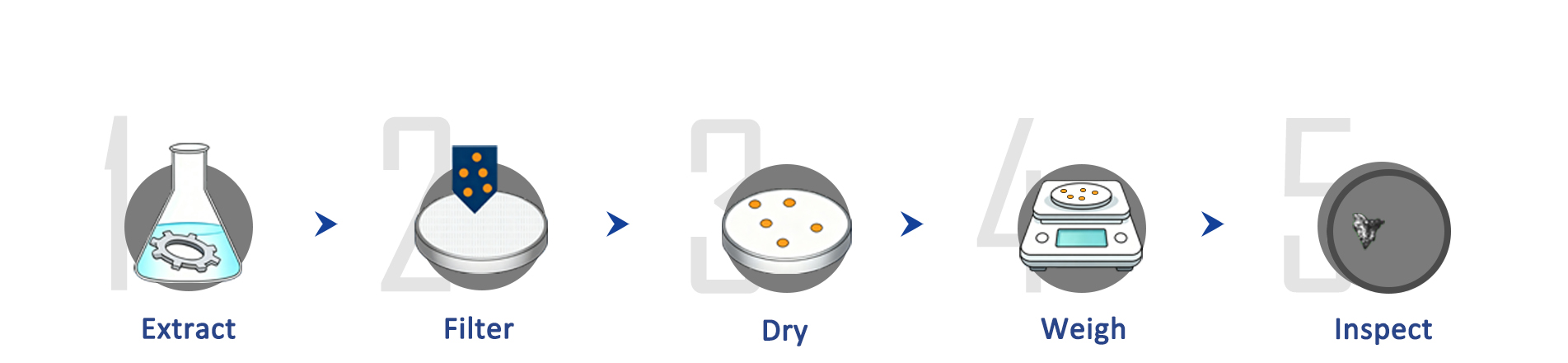




 IPv6 network supported