What is Particle Extraction?
In modern advanced manufacturing sectors such as automotive manufacturing, aerospace, medical devices, and precision electronics, Technical Cleanliness has become a core metric for measuring product quality and reliability. Residual microscopic contaminants—such as metallic chips, dust, fibers, and hard particulates on component surfaces, inside internal cavities, or within tight clearances—can easily trigger critical failures including hydraulic system jamming, abnormal wear of precision parts, electrical short circuits, and seal degradation.
Currently, the universal testing standards across the industry are ISO 16232 (Road vehicles — Cleanliness of components and systems) and VDA 19.1 (Inspection of Technical Cleanliness). Within the technical cleanliness inspection workflow, particle extraction serves as the most critical pre-treatment physical process, directly governing the validity and authenticity of the test data.
1. Definition and Core Objectives of Particle Extraction
Particle extraction refers to a standardised pre-processing procedure adopting purely physical approaches (pressured jet washing, ultrasonic agitation, internal-cavity circulating flushing, clean-gas purging, etc.). It completely detaches solid particulate contaminants adhering to component surfaces, blind holes, inner cavities, threads and micro-crevices, transfers these particles into liquid or gaseous media, and finally achieves particle retention, enrichment and collection via microporous filter membranes.
The complete technical-cleanliness testing workflow follows the sequence:
Particle Extraction → Vacuum Filtration → Filter-membrane Drying & Constant-weight Conditioning → Gravimetric Analysis / Microscopic Particle Analysis. As the first step of the testing workflow, particle extraction serves as a vital link connecting upstream and downstream procedures and directly governs the validity of final test data:
Restore true contamination level Extraction is the only procedure capable of releasing hidden particles from both exterior and interior of components. Incomplete extraction or inappropriate parameters will leave residual particles, yielding severely under-estimated test results that fail to reflect the actual cleanliness status of components.
Strictly control systematic test errors Extraction shall be performed in a closed clean environment to minimise secondary contamination introduced by ambient suspended dust. Blank tests are implemented to quantitatively deduct background interferences originating from equipment, solvents and environment, ensuring test data only characterise residual contaminants generated during product manufacturing and assembly.
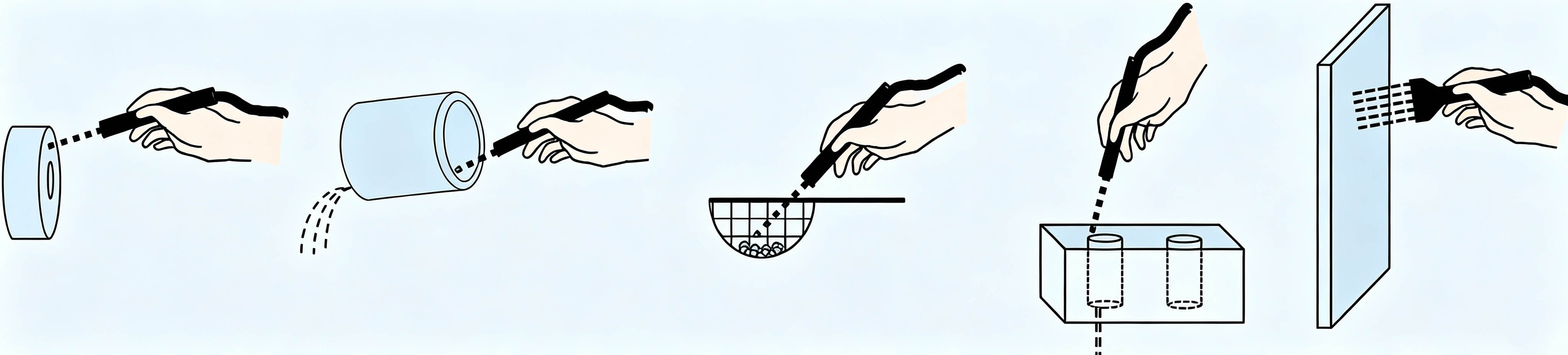
2. Mainstream Industrial Particle-extraction Processes
In compliance with ISO 16232 and VDA 19.1, four standardised extraction methodologies are adopted for components with varied geometries, material properties and sealing configurations, each with defined scope of application and usage constraints:
2.1. Pressure Rinsing Extraction
Technical Principle: Clean extraction solvent at constant pressure and constant flow rate is sprayed onto component outer surfaces, through-holes and shallow grooves following standardised moving trajectories and jet angles. Fluid impact detaches adhered particles, and all rinsing waste liquid is fully collected without omission.
Typical Applications: Medium-to-large-sized components with open structures and accessible surfaces, e.g. engine cylinder blocks, brake discs, housings, shafts and flange parts. It is the most widely-deployed general-purpose extraction method with high stability in industrial practice.
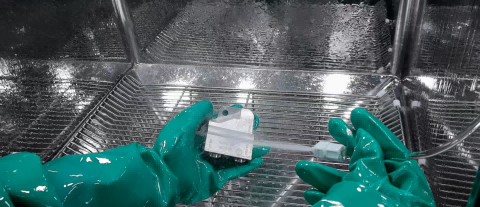
2.2. Ultrasonic Extraction
Technical Principle: The component is fully immersed in clean extraction liquid. High-frequency ultrasound generates cavitation effects within the liquid, producing micro-shockwaves to dislodge stubborn micro-particles adhering to blind holes, micro-crevices and rough cast surfaces.
Typical Applications: Small precision parts with complex structures and inaccessible micro-crevices where regular spraying cannot reach, such as precision valve spools, micro-stamped components and small cast-aluminium parts.
Process Risks & Contraindications: Excessive ultrasonic power or over-long exposure time may induce substrate material detachment and generate artificial pseudo-particles that severely skew test outcomes. Powder-metallurgy parts, porous castings and thin-walled precision components shall be used with caution. Extraction decay tests are mandatory to validate process performance.
2.3. Internal-Flushing / Shaking Extraction
Technical Principle: For closed or semi-closed tubular-cavity components, metered clean solvent is injected into internal spaces. Equipment-driven liquid circulating flushing or sealed mechanical shaking dislodges particles adhering to inner walls, and the extractant is collected integrally.
Typical Applications: Tubular and cavity-type components, including brake pipelines, hydraulic tubing, heat exchangers, oil sumps and sealed valve-cavity assemblies.
2.4. Air-Purging Extraction
Technical Principle: Inside a closed clean chamber under negative pressure, parts are purged with high-purity dry clean air. Airflow entrains particles which are guided onto dedicated filter membranes for retention and collection, with zero liquid contact throughout the procedure.
Typical Applications: Components that prohibit liquid exposure and are susceptible to oxidation-rusting or solvent corrosion, such as precision electronic control modules, circuit boards and electronic components.
Process Limitations: Compared with liquid-phase extraction, air-purging delivers lower particle-recovery efficiency and poorer test repeatability. It is classified as a restricted alternative methodology in relevant standards, applicable exclusively for special workpieces incompatible with liquid washing, and shall not serve as a general-purpose testing solution.
3. Core Quality-control Requirements for Particle Extraction (Mandated by Standards)
To guarantee process repeatability, comparability and validity, VDA 19.1 stipulates that method validation including decay-curve testing and blank-value control must be completed prior to formal deployment of any extraction procedure.
3.1. Extraction Decay-curve Test (Method-validation Confirmation)
Decay testing verifies whether selected parameters (extraction pressure, solvent volume, ultrasonic duration, shaking frequency, etc.) are adequate to achieve full particle extraction without workpiece-substrate damage. Operation: Perform repeated consecutive extraction cycles on one identical specimen. Filter, weigh and statistically analyse particle data after each cycle.
Industry-accepted Criterion: The mass or particle count obtained in one single extraction cycle accounts for less than 10 % of the cumulative total quantity acquired from all prior extraction cycles. If this criterion is satisfied, extraction is deemed complete, parameters are validated and can be fixed into formal Standard Operating Procedures (SOPs).
3.2. Blank-value Control (System-background-interference Mitigation)
Blank tests quantify background-particle interferences stemming from extraction hardware, solvents, labware and ambient conditions. Carry out the full extraction-filtration-drying workflow without loading any test specimen to acquire blank-test results.
Standard Requirements: ISO 16232 and VDA 19.1 do not specify fixed numerical thresholds, yet explicitly require blank background not to exert notable influence over sample test results. A stringent widely-adopted industrial control rule: blank-test particle mass and particle count shall not exceed 10 % of the component-cleanliness limit value.
Environmental Requirements: To stabilise blank values, extraction operations are normally conducted within ISO 5 ~ ISO 7 clean-room environments or enclosed extraction equipment fitted with HEPA high-efficiency filters to eliminate ambient-dust interference.
Summary
Particle extraction constitutes the cornerstone of technical-cleanliness testing. Normativeness, stability and completeness of extraction processes directly determine the credibility of cleanliness data. Unlike ordinary component cleaning, test-grade particle extraction targets full particle recovery, zero artificially-introduced pseudo-contamination, and traceable, repeatable measurement results.
Within high-end-manufacturing quality-management systems, standardised particle-extraction processes enable accurate quantification of component-cleanliness levels. They also provide feedback for optimising manufacturing, washing and assembly workflows, serving as a vital technical guarantee for long-term reliability of automotive, aerospace, medical-device and precision-electronic products.
FAQ
Q1: When establishing extraction SOPs, if after repeated sequential extractions the blank-corrected particulate quantity of each extraction cycle still fails to satisfy the decay criterion (“single-extraction particulate quantity < 10 % of cumulative total from all previous cycles”), how should troubleshooting and resolution be performed?
Failure of decay-curve convergence mainly stems from three root causes.
1.Troubleshooting shall be conducted in the sequence below:
Workpiece-substrate detachment generating persistent pseudo-particles (frequently observed in ultrasonic extraction) Excessive ultrasonic power or excessive exposure time causes continuous spalling of porous casting substrates, powder-metallurgy base materials, plating layers or brittle plastic edges. Each extraction cycle generates abundant new-formed particles, hence non-convergent decay curves.
Solutions: Reduce ultrasonic output power or shorten ultrasonic exposure duration. If decay criteria remain unmet after parameter adjustment, switch to milder extraction approaches such as pressure rinsing or internal-cavity circulating flushing.
2.Insufficient extraction intensity leading to incomplete particle detachment Insufficient rinsing pressure, inadequate solvent volume or sub-optimal jet angles mean stubborn contaminants (e.g. metal chips encapsulated by oil residues) inside component crevices and blind holes are only partially eluted in each cycle.
Solutions: Appropriately increase rinsing pressure and total solvent dosage and optimise jet-spray angles without inflicting workpiece damage, so as to enhance particle-detachment capacity.
3.System-background-noise interference Legacy contaminants remain inside equipment chambers and pipelines, or high intrinsic particle levels exist within extraction solvents and filter membranes. When blank-test values approach sample-extraction particulate magnitudes, raw measurement data is masked by background noise and decay-ratio calculation becomes invalid.
Solutions: Suspend method-validation activities. Execute equipment self-cleaning and complete blank-value qualification. All decay-test datasets shall be blank-corrected prior to decay-ratio computation. Decay validation shall not proceed until blank-value requirements are fulfilled.
Special supplementary note: If decay-curve non-convergence persists despite full-range parameter tuning, evaluate the intrinsic condition of test components. Continuous shedding of foreign substances originating from incompletely cured adhesive, grinding residues or friable coatings on component surfaces represents a workpiece-intrinsic issue rather than an extraction-method defect. Feedback shall be submitted to upstream manufacturing and cleaning departments for process optimisation.

 English
 Français
 Русский
 Español
 Português
 عربي
عربي Get A Quote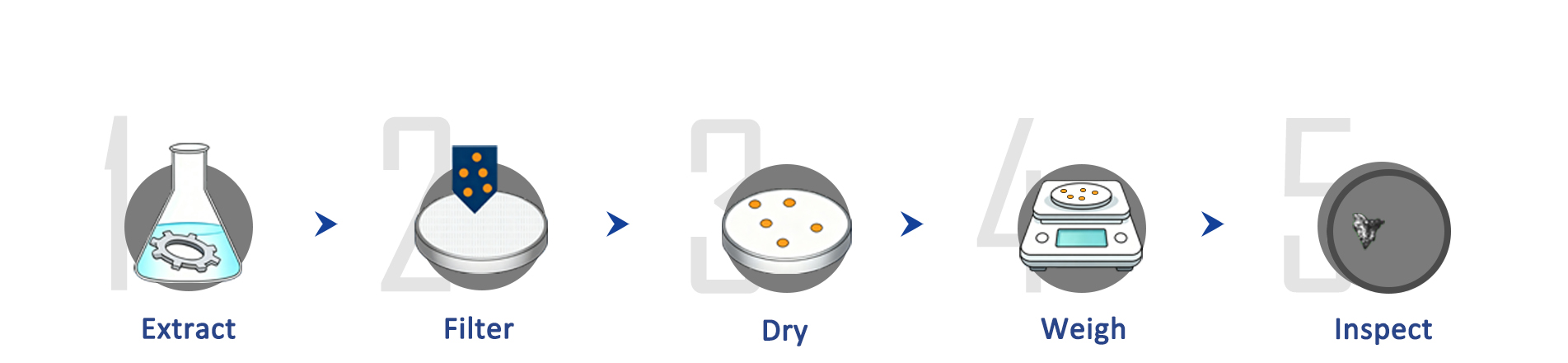




 IPv6 network supported